What Is The 4x4 Area In OBX? Corolla's Off-Road Beach Explained
A clear explanation of the Outer Banks 4x4 area north of Corolla: where it starts, who can drive it, the wild horse rules, and how the guided 4WD truck tour fits in.
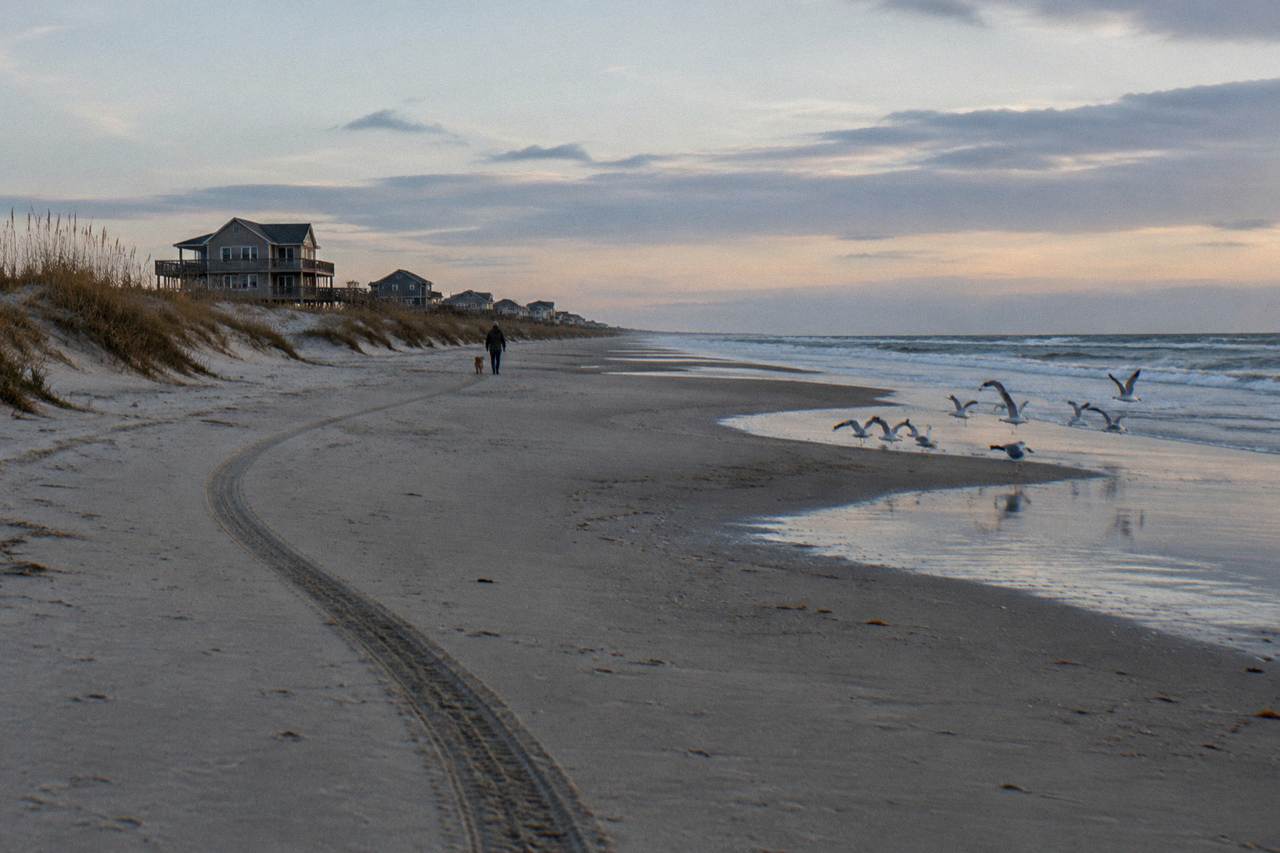
The pavement of NC-12 ends in Corolla, and from that point north to the Virginia state line the beach itself is the road. Locals call it the 4x4 area, the off-road area, or the north beach, and it is the last stretch of drivable oceanfront on this part of the Outer Banks. It is also home to the Corolla wild horses, which is why almost every wild horse tour in town, including the 2-hour open-air 4WD truck tour that runs from a meeting point on Ocean Trail, spends its time up there. The 4x4 area is the stretch of beach north of where the paved road ends in Corolla, open to vehicles with four-wheel drive, and it comes with its own driving rules once you are rolling on sand. If seeing the horses is the main reason you're heading up there, our guide to every bookable wild horse tour on the Outer Banks explains which trips you can reserve ahead of time.
Where Is The Off-Road Beach In Corolla?
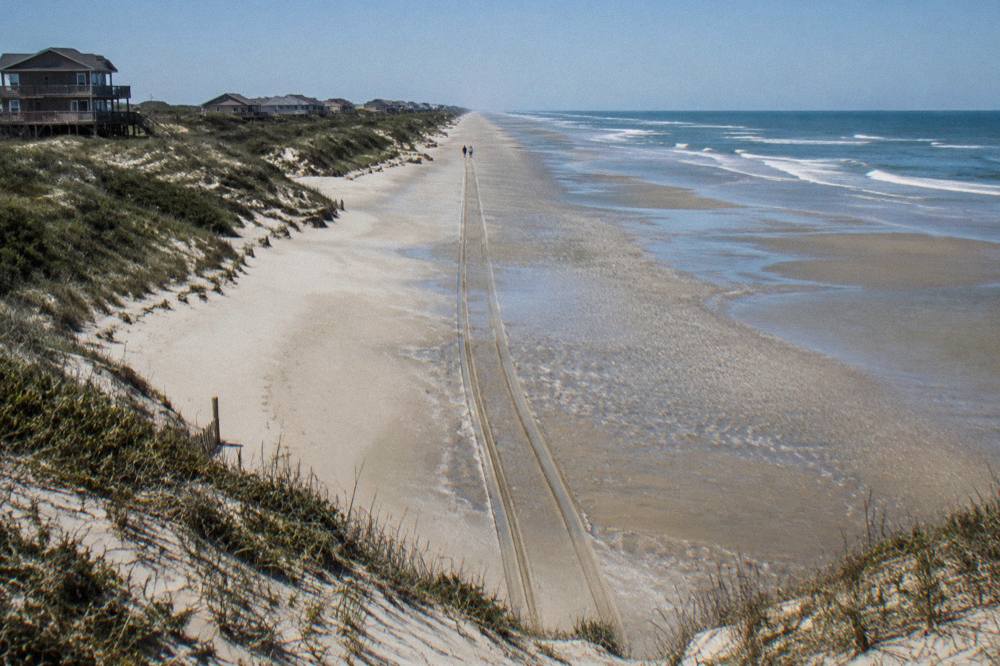
The 4x4 area is the roughly eleven-mile stretch of Currituck County beach between the northern terminus of paved NC-12 in Corolla and the Virginia state line, where the sand itself serves as a public road and four-wheel drive is required to travel it. It holds the communities of Carova, North Swan Beach, and Swan Beach, and it is the year-round home range of the Corolla wild horses across 7,544 acres of habitat. Because the horses roam freely across that habitat rather than staying put in one spot, knowing exactly where to look for the Corolla wild horses by season can make the difference between a sighting and a missed one.
The name is literal. Where every other Outer Banks town sits at the end of a paved highway, the northern tip of the barrier island never got one. The Corolla Wild Horse Fund's history of the area explains that the beach north of the paved road "is considered public road, and it is open to the public," and that it is the only access for residents and guests staying in Carova, North Swan Beach, and Swan Beach. So the beach is not a trail or an attraction in the usual sense. It is a functioning road with houses along it, mail delivery, emergency vehicles, and a speed etiquette all its own.
The US Fish and Wildlife Service describes the same access reality for the refuge lands that sit behind and around that beach: follow NC-12 north to its terminus in Corolla, where "traffic is then diverted to the beach (four-wheel drive is required)," and refuge access "is by 4WD vehicle or boat only." The refuge's visitor page also notes that vehicle traffic is restricted to the beachfront itself, so you cannot cut inland on old jeep paths just because a track looks inviting.
For visitors, the practical effect is that the 4x4 area splits into two experiences. If you have a four-wheel-drive vehicle and some comfort driving on sand, you can drive yourself up the beach, watch for horses from a legal distance, and park where allowed. If you do not, or you would rather not risk your rental contract, the guided 4WD truck tour is the established way in: an open-air truck, a driver who reads the sand and the tides every day, and a guide who knows where the harems have been hanging out. Either way, the same beach, the same rules, and the same horses.
Where Exactly Does The 4x4 Area Start And End?
The southern boundary is the end of the paved portion of NC-12 in Corolla, just past the residential streets of the village, and the northern boundary is a fence at the Virginia state line roughly eleven miles up the beach. Everything between those two points, sand, dune line, and the maritime forest behind it, functions as the off-road zone.
The southern end is easy to find because the asphalt simply stops. Drivers air down, engage four-wheel drive at the ramp, and roll onto the beach. Currituck County guidance asks drivers to use 4WD when entering and to maintain a slow, steady speed, and to not attempt the beach at all in a two-wheel-drive vehicle. County guidance says the same thing to tour operators: their vehicles must stay on the sand and behave like traffic, not like off-road toys.
The northern end is a fence, and the Fund's history pages note it sits "approximately eleven miles north, at the Virginia state line." The fence is a management boundary, not a scenic one. It keeps the Corolla herd from wandering into Virginia, where a different wild horse population lives, and it marks the point where even four-wheel-drive traffic has to stop. Between the two ends sit the three off-road communities, the 7,544 acres the Fund manages across, and, west of the dune line, the marsh and forest land of the Currituck National Wildlife Refuge.
| Boundary or zone | What it is | What it means for visitors |
|---|---|---|
| Southern end (Corolla) | Terminus of paved NC-12 | Last pavement; engage 4WD here, no two-wheel-drive vehicles |
| The beach itself | Public sand road, the only access to Carova, North Swan Beach, and Swan Beach | Drive slow and steady, watch for horses, people, and parked vehicles |
| West of the dune line | Refuge and private land behind the beach | Vehicle traffic restricted to the beachfront only |
| Northern end | Fence at the Virginia state line, about eleven miles north | Hard stop for driving and for the herd's range |
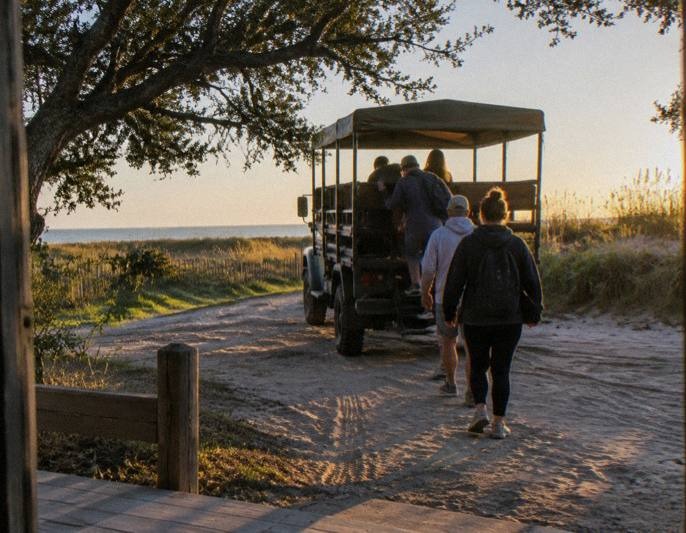
One detail that surprises first-time visitors: the paved and the unpaved worlds sit a few hundred yards apart. The tour trucks leave from a meeting point at 1148 Ocean Trail in Corolla, on regular streets with shops and parking lots, and within minutes they are on the sand. That contrast, pavement to wilderness in the space of a neighborhood, is a genuine part of the area's character, and it is why a two-hour tour can cover so much ground.
If the question behind your question is whether your own car can make it, the honest answer is on our piece about whether you need a 4x4 for Carova Beach, which goes deeper on vehicles, recovery, and tide timing than this overview can.
Can You Drive Through The 4x4 Area Yourself?
Yes, the beach is a public road open to any properly equipped four-wheel-drive vehicle, and no permit or entry fee for visitor driving was found on any official page, but county guidance is firm that two-wheel-drive vehicles should not attempt it and that drivers keep a slow, steady speed. Sand driving, tides, and soft spots are the real constraints, not gatekeepers.
The freedom is real and so is the responsibility. Because the beach is a road, ordinary traffic law and the wild horse ordinance both apply in full. County guidance on entering the ramp is to use 4WD and maintain a slow steady speed; no official source publishes a numeric beach speed limit, so treat "slow and steady" as the actual rule rather than looking for a sign that does not exist. No county or state office appears to run a visitor permit program for driving this beach, which is unusual for a drivable beach and worth knowing before you budget for one.
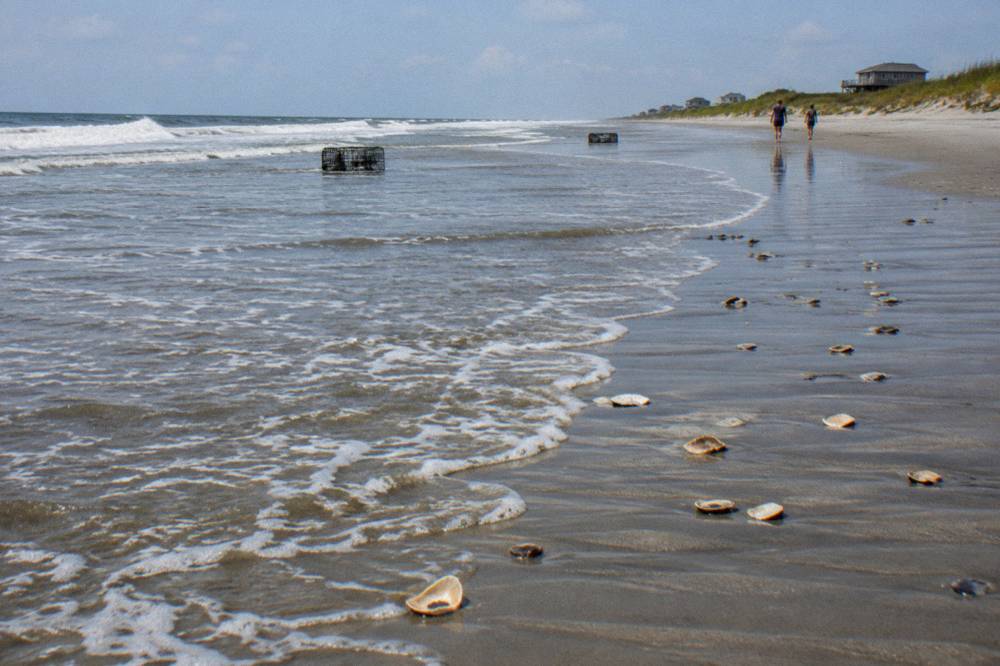
The skill floor is what catches people out. Soft sand near the dune line, a rising tide that pinches the drivable corridor against the water, and the classic mistake of stopping in loose sand instead of on firmer wet sand: these cause more stuck vehicles than anything else. Rental contracts matter too, since most standard rentals exclude beach driving entirely, and a recovery tow on the north beach is neither cheap nor fast. Our comparison of driving the beach yourself versus taking a guided tour walks through the trade-offs in detail.
Against that, the guided option exists precisely because most visitors arrive without a 4x4. The featured Corolla horse tour handles the driving entirely: an open-air 4-wheel drive truck, a maximum of 12 travelers per departure, and a guide whose job includes both finding horses and keeping the vehicle out of trouble. It runs about two hours, is rated 4.8 across 2,871 reviews, and costs from $65 per person, with the booking page showing the live price. For a family that wants the 4x4 area without the sand-driving risk, that is the whole value proposition in one sentence.
| Driving yourself | The guided 4WD truck tour | |
|---|---|---|
| Vehicle needed | Your own 4x4, aired down for sand | None; open-air tour truck, max 12 travelers |
| Route decisions | You read tide, sand, and parking rules | Guide and driver handle all of it |
| Horse finding | Wherever luck and distance allow | Guide tracks the harems daily |
| Rules compliance | Entirely on you, including the 50-foot rule | Licensed operator held to county rules |
| Cost structure | Vehicle wear, fuel, recovery risk | From $65 per person |
What Are The Wild Horse Rules Inside The 4x4 Area?
Currituck County's wild horse ordinance makes it unlawful to come within 50 feet of a wild horse and unlawful to feed, pet, or ride one, and the rules apply to everyone regardless of experience. Tour operators face their own county rules, including no operations west of the dune line before 8 a.m. or after 8 p.m., no amplified sound there at any time, and licensed vehicles that must also stay 50 feet from the horses.
The 50-foot rule is the one every visitor should memorize. The Fund's FAQ puts it plainly: a county ordinance makes it illegal to come within 50 feet of the horses regardless of a person's experience, and if horses approach you on the beach, it is your responsibility to keep the distance. The Fund states that feeding the horses or getting too close is punishable by law. On the federal side, the wildlife refuge adds its own layer: it is unlawful to harm, approach, feed, or kill any wild horse on the refuge.
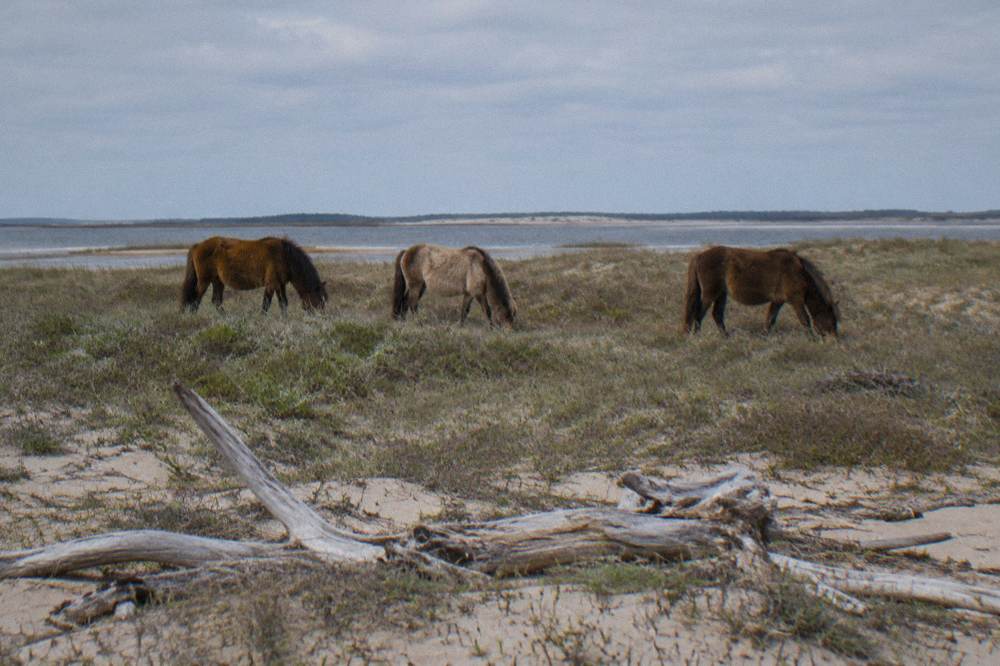
Tour operators are regulated separately by the county, which is worth understanding because it explains why tour trucks behave the way they do. The county's tour rules page requires valid state license tags and county-issued yearly identification on every tour vehicle, restricts tour operation west of the dune line to the hours between 8 a.m. and 8 p.m., bans amplified sound in that zone entirely, and states that tour vehicles should stay at least 50 feet from the wild horses. Violations bring citations, and repeat citations can cost an operator its license, which is a strong incentive for the licensed trucks to keep their distance even when a harem wanders close.
For a self-driving visitor, the practical translation is simple. Never approach horses, never feed them, never try to touch one, and if a horse walks toward your spot on the beach, you move back. If you are on the guided 4WD tour, the driver manages the legal spacing while the guide narrates, which is one of the quieter advantages of the format: nobody in your party has to make a judgment call under excitement. Our fuller rundown of the 50-foot rule and beach etiquette covers the details, including what to do if you spot an injured horse.
How Does The Guided Tour Use The 4x4 Area?
The 2-hour Outer Banks Wild Horse Tour by 4WD Truck operates entirely within the off-road zone, taking up to 12 travelers from its Ocean Trail meeting point onto the sand in an open-air truck to look for wild horses while observing the county's 50-foot and hours rules. It is rated 4.8 across 2,871 reviews and costs from $65 per person.
The mechanics matter more than the marketing. The listing describes transport by open air 4-wheel drive truck with no ATVs, a friendly professional guide, a meeting point at 1148 Ocean Trail in Corolla, and a roughly two-hour runtime. Food, drinks, and hotel pickup are not included, the truck is not wheelchair accessible, moderate physical fitness is recommended, and children under five years or 40 pounds cannot be accommodated. Those constraints come straight from the listing, and they shape who the tour suits: families with school-age kids, couples, and groups who want the off-road experience without owning the off-road experience.
Why the open-air format specifically? Because the 4x4 area rewards it. An enclosed SUV tour, which one direct operator runs in winter months, protects you from January wind but puts glass between you and the scene. In the warm season, the open truck delivers the salt air, the engine-down moments in soft sand, and sightlines in every direction, which is genuinely useful when a harem is grazing off to the side. The featured tour is a warm-season product, and the format is part of what people are buying.
For planning, note that the county's 8 a.m. to 8 p.m. window for tour operations west of the dune line frames every departure on the schedule. Booking ahead is the norm in summer, and the booking page shows the live price and current departure times. If your dates are fixed around a weekend or a holiday week, reserving early costs nothing extra and avoids the sold-out days that fill first.
Can You Enjoy The 4x4 Area Without Four-Wheel Drive?
Yes, in three ways: take the guided 4WD truck tour and let someone else drive, walk in from the paved end of NC-12 along the beach, or view horses from legal distances around the Corolla village area where the herd sometimes grazes near the boundary. The refuge also permits parking on the beach and walking in where access allows.
The walking option is underused. The beach is public, and the first stretch north of the pavement is reachable on foot from the Corolla end. You will not cover eleven miles, but you do not need to: horses move seasonally and daily, and in warm months the herd spends more time on the open beach where flies and heat push them out of the cover, which the Fund's own seasonal observations confirm. Walkers still owe the horses 50 feet, the same as any truck. Our guide to seeing the Corolla wild horses without a tour maps the realistic free and self-guided options.
The guided tour remains the answer for most people, and that is a fact about the geography more than a sales pitch: the distance, the sand, and the tide combine to make the heart of the 4x4 area effectively closed to anyone without a capable vehicle. The 4WD truck tour, from $65 per person and rated 4.8 across 2,871 reviews, is the one Corolla horse tour sold through a third-party booking platform, with a live calendar and a public review count, while the direct operators take bookings on their own websites and by phone. That distinction matters if you like a confirmed reservation before you drive to the beach. Discover the full range of options through Corolla North Carolina Horse Tours.
A third path is timing. The Fund's museum and gift shop on Corolla Village Road, open seasonally Tuesday through Saturday from 10 a.m. to 4 p.m., sits on the paved side of the line and offers context, maps, and the story of the herd's management without any vehicle at all. Pair a museum stop with a booked truck tour and you get both the history and the sand in one afternoon, all without touching a steering wheel on the beach.
The 4x4 area, in the end, is less a place than a condition: it is what the northern Outer Banks looks like when the road budget ran out and the horses stayed. Whether you drive it, ride it in an open truck with eleven strangers and a guide, or walk its first mile on foot, the rules are the same ones we have laid out here, and the beach does not bend them for anyone.
Common Questions About The OBX 4x4 Area
What is the 4x4 area in OBX?
It is the roughly eleven-mile stretch of beach between the northern end of paved NC-12 in Corolla and the Virginia state line, where the sand serves as a public road and four-wheel drive is required. It contains the communities of Carova, North Swan Beach, and Swan Beach, plus the range of the Corolla wild horses across 7,544 acres.
Do you need a permit to drive on the beach at Corolla?
No county or state source lists a visitor permit for driving this beach. What official guidance does require is a four-wheel-drive vehicle, a slow steady speed, and staying off the beach entirely if your vehicle lacks 4WD. Rental car contracts often bar beach driving regardless of capability.
Can wild horses walk up to my car in the 4x4 area?
They can and sometimes do, since they roam freely across the habitat. County rules put the responsibility on you: it is illegal to come within 50 feet of a wild horse regardless of your experience, and if horses approach, you are expected to move back and give them the distance.
Is the 4x4 area the same as Carova Beach?
Carova is the best known of the three communities inside the 4x4 area, along with North Swan Beach and Swan Beach. The area as a whole runs from the end of paved NC-12 in Corolla to the fence at the Virginia line, so Carova sits within it rather than defining it.
Can I visit the 4x4 area if I don't have a 4x4 vehicle?
Yes. The guided 4WD truck tour covers the area in an open-air truck with a driver and guide, from $65 per person, and the beach near the paved end can also be explored on foot. The Currituck National Wildlife Refuge page likewise notes the public may park on the beach and walk to refuge land where access allows.