History Of The Corolla Wild Horses And Banker Spanish Mustangs
The wild horses of Corolla have grazed the northern Outer Banks for centuries, surviving storms, development, and a paved road that killed eleven of them before a local nonprofit stepped in.
Short answer
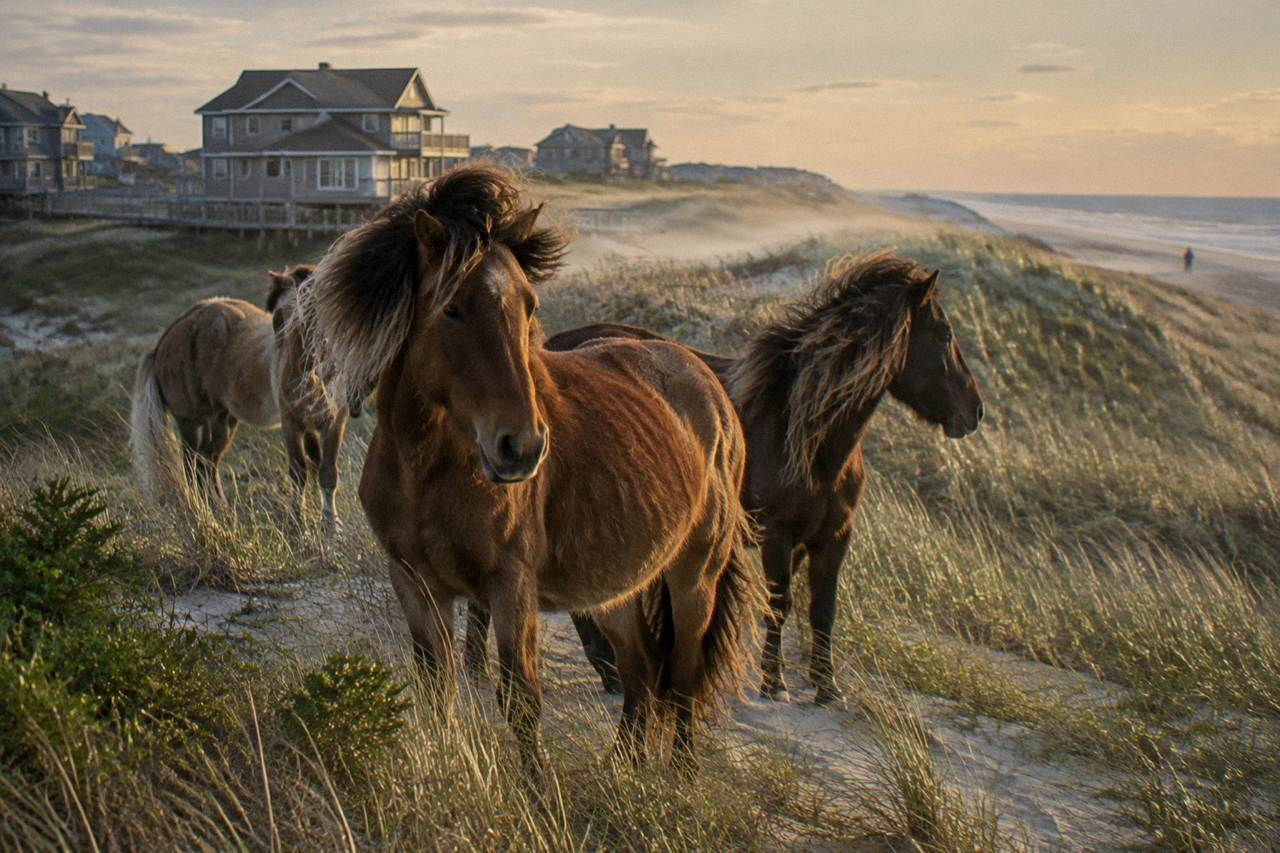
The Corolla herd descends from Spanish colonial mustangs brought to the Banks centuries ago. When NC-12 was paved in 1985, eleven horses were killed on the road by 1989, prompting the Corolla Wild Horse Fund, organized in 1989 and incorporated in 2001. North Carolina named the Colonial Spanish Mustang its state horse in June 2010.
The horses grazing the dune lines north of Corolla are not strays and not recent arrivals. They are the last visible piece of a colonial livestock tradition that once ran the full length of the Outer Banks, and their survival into the present required a long run of accidents, a stretch of bad luck with a paved road, and, eventually, a county ordinance backed by the force of law. Their story explains why the animals behave the way they do, why the beach north of the paved road is closed to them at its southern end by a fence, and why a Corolla North Carolina Horse Tours page exists at all: the herd is the single largest draw in the northern Outer Banks, and the guided 4WD truck tour is how most visitors actually reach it.
This guide walks through the documented history: the Spanish colonial origin story, the isolation that preserved the bloodline, the paving of NC-12 in 1985 and the eleven horses killed on it by 1989, the founding of the Corolla Wild Horse Fund, and the herd's management today. Where a claim comes from the Fund's own pages, it is presented as the Fund states it; where the record is thinner, the gaps are named rather than papered over.
How Did Wild Horses Get To Outer Banks?
No ship's manifest names the vessel that delivered them, so the honest answer is a hedged one: the Fund says the herd descends from Spanish mustangs that reached the Banks in the colonial era, most likely through shipwrecks and abandoned or escaped livestock. What is certain is that the horses were on the Banks long before the first bridge, the first paved road, or the first tourism brochure, and nothing about their presence was planned.
The origin story told on the Outer Banks begins with Spanish colonial expansion along the Carolina coast. Spanish expeditions carried livestock, including Iberian horses, and the region's shoal-lined waters claimed a steady toll of vessels. The Fund's account holds that some of these animals swam ashore or were left behind at failed settlements, and that their descendants spread across the barrier islands, where they became known as Banker horses. The horses the Fund manages today at Corolla are described as Colonial Spanish Mustangs, a designation the Fund traces through both documented history and genetics. For the full story of how the herd ended up north of the paved road, see how the wild horses came to the Outer Banks.
It is worth being precise about what is and is not documented. The Fund says the herd is of Spanish colonial descent; no official source confirms specific ship names, dates, or wreck sites beyond that general account, and pages that list them with confidence are filling in what the primary sources leave blank. What the record does support is the outcome: a population of small, hardy horses adapted to the island's rough forage, salt water, and storm cycles, living wild on the Banks for centuries before anyone thought to count them.
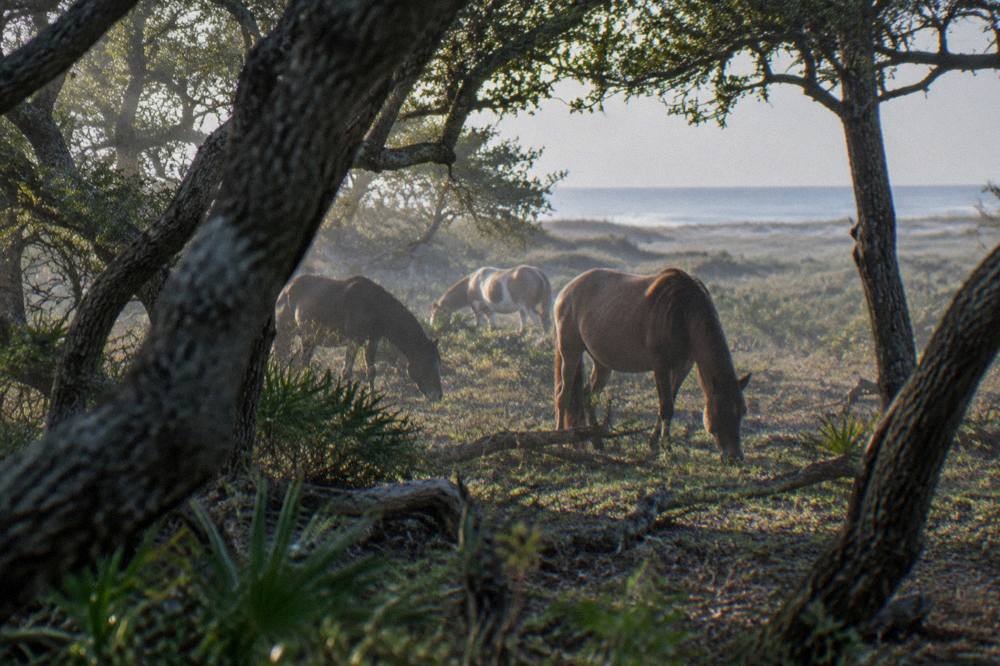
The isolation mattered as much as the arrival. For most of the centuries since the horses established themselves, the northern Banks had no road at all. The land between Duck and Corolla was a trackless stretch of sand and marsh, and the horses north of it bred with little outside influence. That accident of geography preserved a bloodline that, on most of the East Coast, was diluted or erased long ago. The Fund states that the horses are managed today on 7,544 acres of diverse habitat between the northern edge of Corolla and the Virginia state line, a range that includes roughly 700 houses, thousands of people and vehicles, and a mix of 70 percent private land and 30 percent public use.
That last detail is the hinge of the whole modern story. The horses did not live on empty wilderness when the modern development era arrived; they lived on land that was about to be platted, built on, and driven.
What Happened When NC-12 Was Paved In 1985?
The road between Duck and Corolla was paved in 1985, and the consequences were lethal: between 1985 and 1989, eleven horses were hit and killed on Highway 12, a toll that shocked residents and officials into action. The Fund's own history page counts those eleven deaths as the triggering event for everything that followed, including the organized response in 1989 and the relocation of the horses that frequented Corolla to the north beach.
The Fund's history page is the primary account, and its numbers deserve to be stated plainly. Before the paving, the horses crossed the sandy track between Corolla and the villages to the south as they had for generations. Asphalt changed the physics: cars moved faster, the drivers were visitors rather than locals who knew where horses crossed, and the horses had no reason to treat the road as a boundary. Eleven deaths in four years, on a road serving a small community, was an impossible number to ignore.
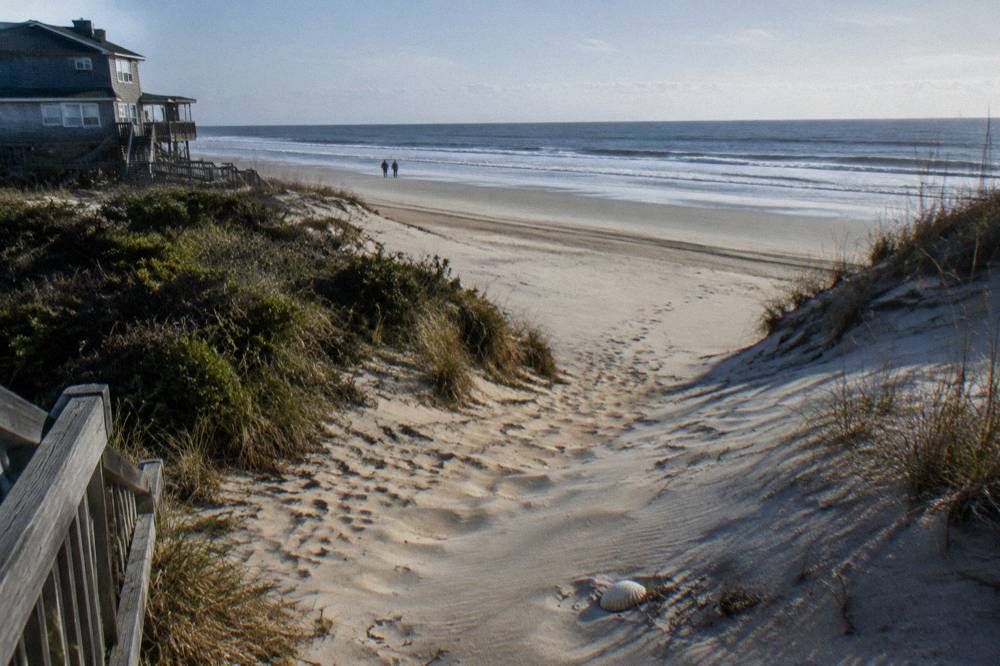
The response had two parts, and both shaped the herd you can see today. First, the horses that frequented Corolla were moved north of the paved road to the north beach, the stretch between the end of NC-12 and the Virginia line that remains unpaved and drivable only by four-wheel-drive vehicles. The Fund's history page notes that this beach is considered a public road and is the only access for residents and guests staying in Carova, North Swan Beach, and Swan Beach. Second, a fence now marks the northern boundary of the paved world, and the herd lives beyond it.
| Date | Event | Source |
|---|---|---|
| 1985 | NC-12 between Duck and Corolla is paved | Fund history page |
| 1985 to 1989 | Eleven horses hit and killed on Highway 12 | Fund history page |
| 1989 | Corolla Wild Horse Fund organized | Fund history page |
| 2001 | Fund incorporates as a 501(c)(3) | Fund history page |
| June 2010 | Colonial Spanish Mustang named North Carolina's state horse, Session Law 2010-6 | Fund ordinances page |
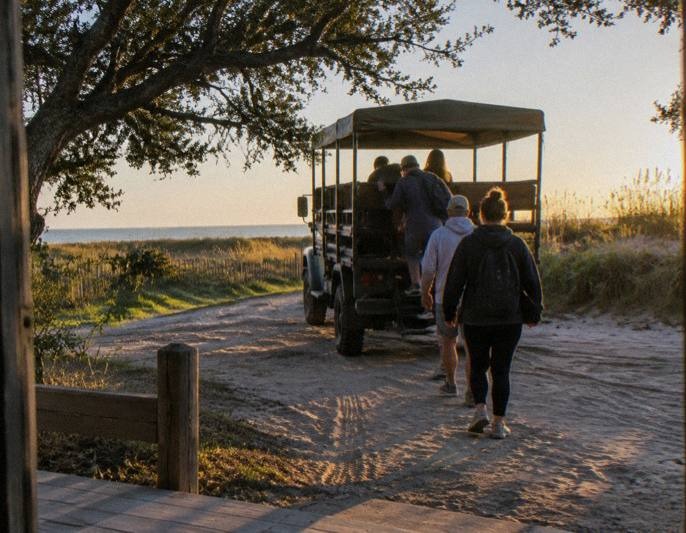
That geography is why seeing the horses takes effort. The range is a working landscape of rental houses, sand roads, and open beach, not a park with an entrance gate, and it is why the guided tour exists in its current form: the 2-hour open-air 4WD truck tour from the meeting point at 1148 Ocean Trail in Corolla carries up to 12 travelers into the 4x4 area with a guide who knows where the bands have been. Readers weighing that option against driving themselves can start with the driving versus guided tour comparison.
The fence and the relocation solved the road-death problem, but they created a management problem that has defined the decades since: a wild herd, confined to a finite stretch of land, sharing it with an ever-growing number of houses, vehicles, and visitors. The Fund was built to handle exactly that.
Why Was The Corolla Wild Horse Fund Created?
The Corolla Wild Horse Fund was organized in 1989, directly in response to the Highway 12 deaths, and incorporated as a 501(c)(3) nonprofit in 2001. Its stated mission is to protect, conserve, and responsibly manage the herd of wild Colonial Spanish Mustangs of Corolla, work that now spans herd management, rescue and adoption of horses that cannot live wild, and the museum and educational programming in Corolla village.
The Fund's own history is the source here, and the two dates matter. In 1989 there was no standing organization, just residents and officials reacting to dead horses on a new road; the organization that formed proved durable enough that by 2001 it incorporated formally as a charity. The Fund's current posture is that of a working land-and-animal manager rather than a pure advocacy group.
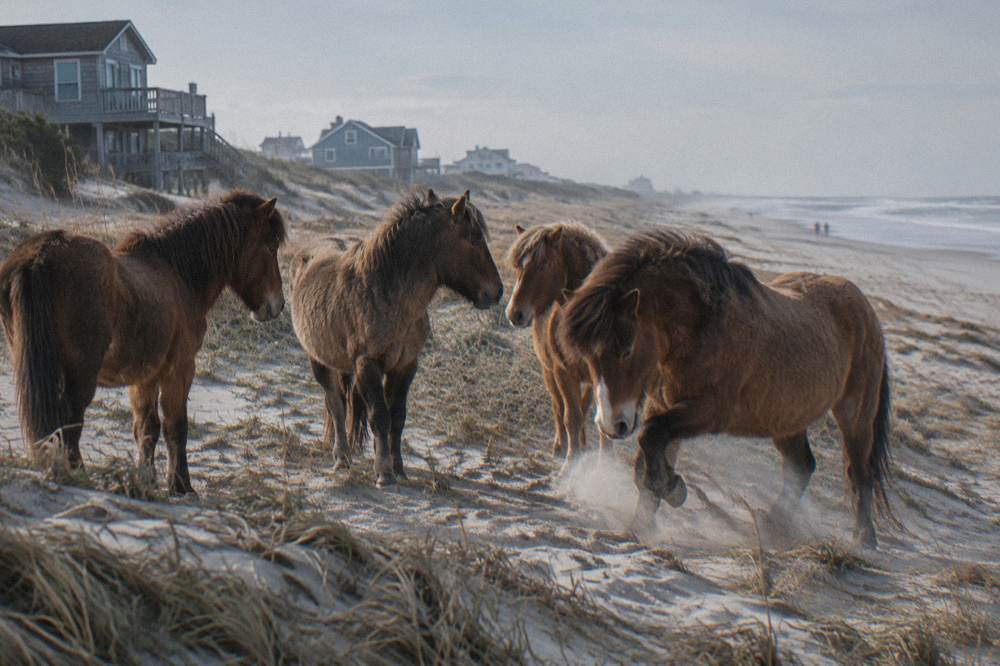
Its management toolkit, described on the Fund's herd-management page, is practical and specific. Horses are identified by color, markings, and home territory rather than by branding or microchips, which keeps the animals genuinely wild in appearance and handling. As many as six aerial counts are conducted by helicopter, and the Fund reports herd figures to the County's Wild Horse Advisory Board. The Fund also uses PZP immunocontraception, a non-hormonal birth-control vaccine, to keep the population within what the 7,544-acre range can support, a necessary step when the herd shares its land with roughly 700 houses and no natural predators remain on the Banks.
The Fund's educational arm is the part most visitors actually encounter. The museum and gift shop at 1130E Corolla Village Road in Corolla village, open seasonally Tuesday through Saturday, covers the herd's history and biology, and the Fund's public events at its mainland farm in Grandy give people a managed way to meet rescued horses. The full rundown of hours, the farm's event calendar, and what a visit adds to a trip is in the museum and Mustang Mornings guide.
The Fund's work also has a legal shadow. Currituck County's wild horse ordinance makes feeding the horses or coming within 50 feet of them punishable by law, and the County imposes its own rules on commercial tour operators, all stated on the County's horse tours page. The ordinance's origin traces to the same era of conflict that produced the Fund.
How Is The Herd Managed Today?
Today the Fund manages the herd on 7,544 acres between Corolla and the Virginia line, using identification by markings and territory, up to six helicopter aerial counts a year, and PZP immunocontraception to hold the population steady. The Fund reports herd figures to the Currituck County Wild Horse Advisory Board, and Currituck County and the federal wildlife refuge each add their own protective rules on top.
Management is a balancing act between two failure modes. Let the herd grow and it outstrips the range's forage and the tolerance of the human residents; shrink it too far and the genetic base narrows toward inbreeding. The Fund's answer is the program described above, with the aerial census as the measurement tool that tells the County whether the balance is holding.
| Management tool | How it works | What the Fund says |
|---|---|---|
| Identification | Color, markings, and home territory | Horses are "not branded or micro chipped" |
| Aerial census | Up to six helicopter counts | "As many as six aerial counts are conducted by helicopter" |
| Population control | PZP immunocontraception vaccine | Keeps numbers within what the range supports |
| Habitat | 7,544 acres north of Corolla | Roughly 700 houses, 70% private land, 30% public use |
| Reporting | Figures to the Wild Horse Advisory Board | Fund reports to the County board |
The horses' movement patterns complicate the job, and the Fund's own updates describe them honestly. The horses relocate seasonally and predictably in response to conditions that repeat every year: in spring, biting flies and shifting winds push them out of secluded cover and onto the open beach, and in summer, heat stress does the same work the insects did earlier. Observers sometimes read this as the herd growing or vanishing; the reality is that the same animals are simply easier or harder to find. Visitors planning around this can use the guide to where the horses are and when.

The seasons also bring the foals, which the Fund announces and tracks publicly. Four healthy foals were spotted roaming free by late April in the most recent spring count, and by late summer local reporting counted twelve healthy foals for the year, seven fillies and five colts, with a note that one or two more could still arrive before the season closed. Each announcement comes with the same caution: foals are extremely impressionable in their first months, and the Fund warns that getting too close can stress the bands and separate a foal from its mother. That caution is not bureaucratic padding. Two horses died after being struck by vehicles in a recent year, four were struck in total, and the Fund asks that dangerous behavior be reported to County dispatch at 252-453-3633.
The federal layer matters too. The Currituck National Wildlife Refuge, which spans six units of maritime forest and brackish marsh north of Corolla, states plainly that it is unlawful to harm, approach, feed, or kill any wild horse on the refuge, and its pages describe the horses as feral mammals that must only be viewed from a distance. The refuge has no developed facilities, no roads, and no restrooms; it is open sunrise to sunset and reachable by boat or four-wheel-drive vehicle only.
When Did The Colonial Spanish Mustang Become The State Horse?
In June 2010 the North Carolina General Assembly adopted the Colonial Spanish Mustang as the Official Horse of the State of North Carolina, under Session Law 2010-6, a designation the Fund cites on its ordinances page. The honor formally recognized what the herd's history had long suggested: that the Banker horses of the northern Outer Banks are a surviving colonial-era Spanish population, a distinction no other feral herd on the East Coast can claim as cleanly.
The designation reads as a small thing, a legislative resolution, but it carried real weight for the herd's protection. A state symbol invites state-level attention, and the Fund cites the designation in the context of the county ordinances that give the herd legal standing. The 2010 law landed two decades into the Fund's existence, a period in which the herd had gone from a road-kill statistic to a managed population with a named lineage.
Recognition also changed how the herd is framed for visitors. Before 2010, the horses were a local curiosity with a history; after it, they were the state horse, a framing that shows up in school curricula, tourism copy, and the naming of local businesses. The Fund's own museum leans on it, and tour guides, including the guides on the 2-hour 4WD truck tour, use the state-horse story as the anchor of the tour's historical narration.
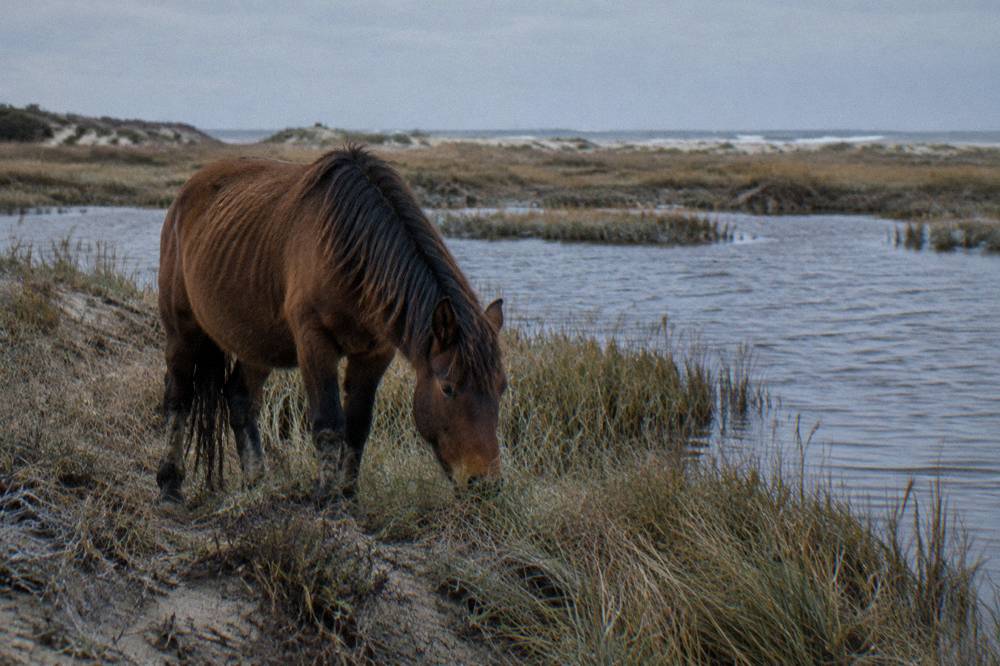
The distinction between the Corolla herd and the state's other Banker population is worth one sentence here: the Shackleford Banks herd, near Cape Lookout to the south, shares the Spanish colonial lineage and its own state recognition, but the two herds are managed separately by different organizations. The Corolla herd is the one accessible by road, which is why nearly all the horse tourism on the Outer Banks concentrates at the northern end.
What Does The Herd's History Mean For Visitors Today?
For visitors, the history explains the rules: the 50-foot distance, the ban on feeding and petting, the fence at the end of the paved road, and the licensed-truck format of the commercial tours all descend directly from the events of 1985 to 1989 and the management system built afterward. A visitor who understands that eleven horses died on a paved road understands why the County takes distance violations seriously.
The practical translation is straightforward. The horses are wild animals with legal protection, not a petting attraction, and the County ordinance the Fund quotes makes feeding them or approaching within 50 feet unlawful regardless of a person's experience with horses. The County's tour rules put licensed tour vehicles under the same 50-foot requirement, which is why a guided tour is not just convenient but compliant by design.
| Rule | Who it applies to | Source |
|---|---|---|
| No coming within 50 feet of a wild horse | Everyone, regardless of horse experience | Fund quoting the County ordinance |
| No feeding, riding, petting, or luring | Everyone | Fund quoting the County ordinance |
| Tours prohibited west of the dune line before 8 a.m. and after 8 p.m. | Licensed tour operators | County horse tours page |
| No amplified sound west of the dune line at any time | The 4x4 beach zone | County horse tours page |
| Tour vehicles stay at least 50 feet from the horses | Licensed tour operators | County horse tours page |
The featured tour is a natural fit for a history-minded visitor precisely because the narration carries the story. The listing for the 2-hour Outer Banks Wild Horse Tour by 4WD Truck describes a friendly professional horse guide and transport by open-air four-wheel-drive truck with no ATVs, up to 12 travelers per departure, from $65 per person, and the booking page shows the live price and current schedule. It is rated 4.8 across 2,871 reviews, a pool large enough to read as a genuine verdict rather than a handful of impressions. The tour has real physical requirements worth knowing before booking: it is not wheelchair accessible, it is not recommended for travelers with back problems, it asks moderate physical fitness, and it cannot accommodate children under five years of age or 40 pounds.
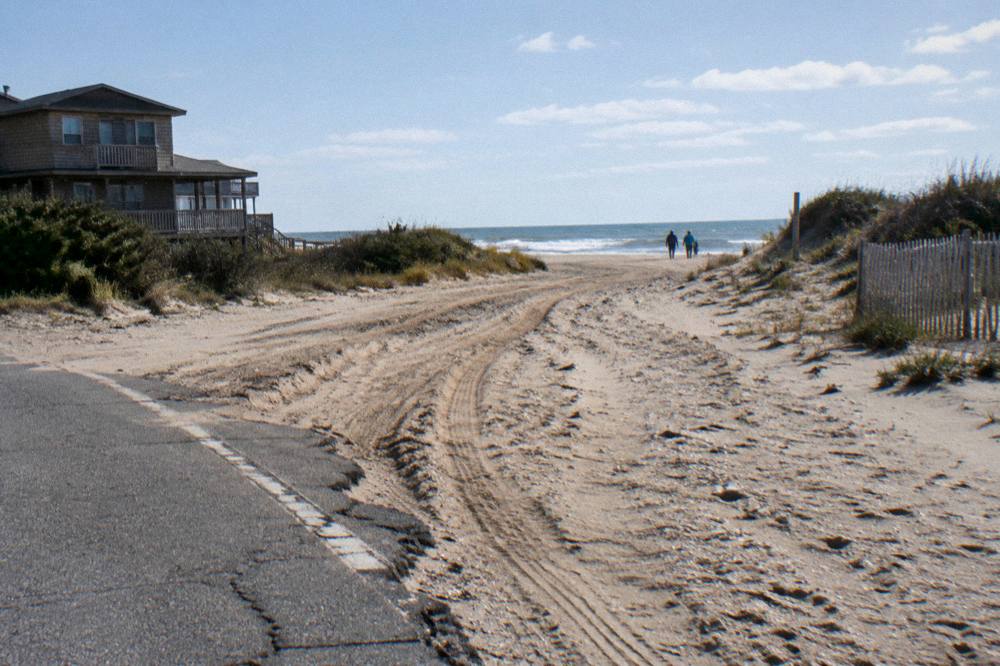
History also explains what the tour cannot promise. The horses roam their full range freely, and no honest operator guarantees a sighting; what the tour guarantees is the licensed vehicle, the guide's local knowledge, and a lawful distance. The months matter less than people assume, though the seasonal movement patterns mean the animals concentrate in the open more in late spring and summer; the planning details are in the best time of year guide.
There is a final symmetry in the story worth naming. The herd survived Spanish colonization, centuries of storms, and the arrival of the automobile age by retreating north of the road that killed eleven of its members. It now survives because a nonprofit counts it from helicopters, manages its numbers with contraception, and talked a county into passing an ordinance with teeth. The horses standing on the beach today are the product of both histories, the wild one and the managed one, and a visitor who knows both sees more than horses.
Common Questions About The Corolla Wild Horses
How did wild horses get to Outer Banks?
The Fund says the herd descends from Spanish mustangs that reached the Banks in the colonial era, most likely through shipwrecks and abandoned or escaped livestock. No specific ship is named in the documented record, and the Fund presents the lineage through its own history and genetics. The horses were established on the islands long before the first paved road arrived in 1985.
When was NC-12 paved, and why did it matter?
The road between Duck and Corolla was paved in 1985. Between 1985 and 1989, eleven horses were hit and killed on Highway 12, according to the Fund's history page. Those deaths led directly to the Fund's organization in 1989 and to the horses that frequented Corolla being moved north of the paved road into what is now the 4x4 area.
When was the Corolla Wild Horse Fund founded?
The Fund was organized in 1989, in response to the Highway 12 deaths, and incorporated as a 501(c)(3) nonprofit in 2001. It manages the herd on 7,544 acres, runs aerial counts by helicopter, uses PZP immunocontraception, and operates a museum and gift shop in Corolla village.
When did the Colonial Spanish Mustang become the North Carolina state horse?
In June 2010, the North Carolina General Assembly adopted the Colonial Spanish Mustang as the Official Horse of the State of North Carolina under Session Law 2010-6. The Fund cites the designation on its ordinances page, and it remains the formal recognition of the herd's colonial-era Spanish lineage.
Are the Corolla horses really Spanish?
The Fund describes them as Colonial Spanish Mustangs, a lineage it traces through documented history and genetics. The specific shipwrecks and release events that delivered the original animals are not documented by name, so the honest framing is the Fund's own: Spanish colonial descent, established centuries ago, preserved by the northern Banks' long isolation.
Can the history affect how I should behave around the horses?
Yes. The 50-foot rule and the ban on feeding, petting, and luring exist because the herd's history includes deadly contact with people and vehicles. Currituck County's wild horse ordinance makes violations punishable by law, and the federal refuge adds its own ban on approaching or feeding the horses. Licensed tours operate under the same distance rules, which makes a guided 4WD truck tour the compliant way to see the herd up close.