How Did Wild Horses Get To Outer Banks?
The origin of the Corolla wild horses, how Colonial Spanish Mustangs came to the Outer Banks, why the herd moved north of the paved road, and how to see them today.
Where Did The Wild Horses Of Corolla Come From?
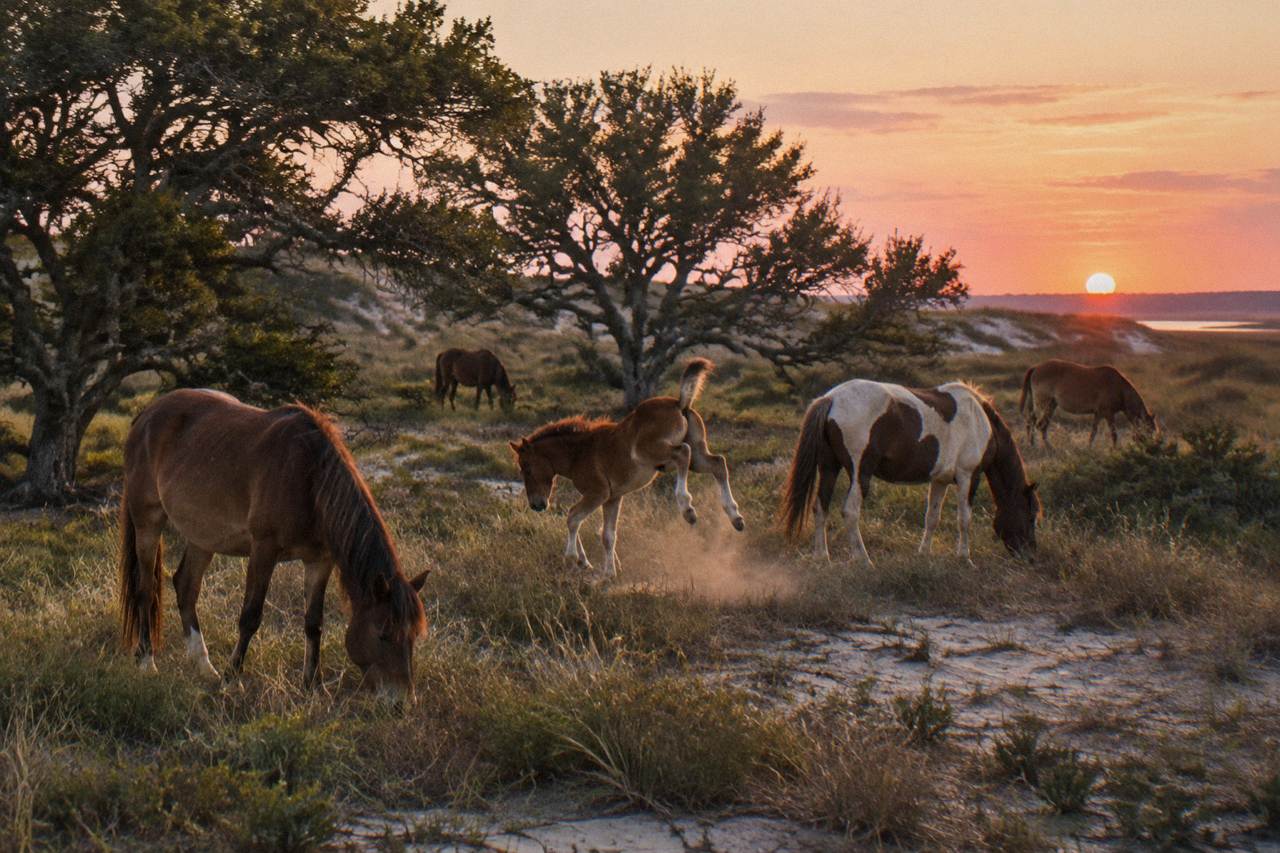
The herd at Corolla is recognized as Colonial Spanish Mustangs, descendants of Spanish horses brought to the Americas in the colonial era, and North Carolina made the breed the Official Horse of the State in 2010. The exact moment the first ancestors stepped onto these barrier islands is not documented, so the Fund describes the lineage rather than a single arrival event.
The short answer carries a long history behind it. Spanish explorers and colonists shipped Iberian horses to the Southeast coast over the early colonial period, and some of those animals, or their descendants, ended up roaming the Outer Banks. What no surviving document fixes is precisely how: a wrecked galleon, an abandoned settlement, or animals simply straying and breeding loose over centuries. The Corolla Wild Horse Fund, the nonprofit that manages the herd today, frames the horses as descendants of Colonial Spanish stock, and the North Carolina General Assembly agreed in June 2010 when it adopted the Colonial Spanish Mustang as the Official Horse of the State of North Carolina under Session Law 2010-6.
That legal recognition matters more than it might sound. It is the state, not a tour company or a local legend, putting its weight behind the lineage claim. For a visitor standing on the sand at Corolla watching a mane flick in the wind, the animal in front of them is a documented remnant of the earliest European horses on this continent, living wild on a landscape that has changed around them for centuries.
The horses roam a range the Fund measures at 7,544 acres of diverse habitat, a strip that includes roughly 700 houses, thousands of people, and vehicles sharing the same sand. That mixture of wild animals and vacation infrastructure is the direct result of the history below, which pushed the herd into the northernmost corner of North Carolina's coast and fenced it there.
What Kind Of Horses Are The Corolla Wild Horses?
They are Colonial Spanish Mustangs, a strain the Corolla Wild Horse Fund identifies by conformation and lineage rather than by registry papers, and the horses are not branded or microchipped. The Fund tracks individuals by color, markings, and home territory instead, manages reproduction with PZP immunocontraception, and gauges herd size through as many as six aerial counts conducted by helicopter.
The term "mustang" here does not mean the feral scratch-coat of popular imagination. Colonial Spanish horses carry a distinctive mix of traits: compact, sturdy frames, a smooth ambling gait in some lines, and a hardiness that let them survive on marsh grass and sand spartina through hurricanes, insects, and lean winters. On the Outer Banks those traits were not ornamental. They were the price of survival, and the horses that could not tough out a barrier island winter simply did not leave descendants.
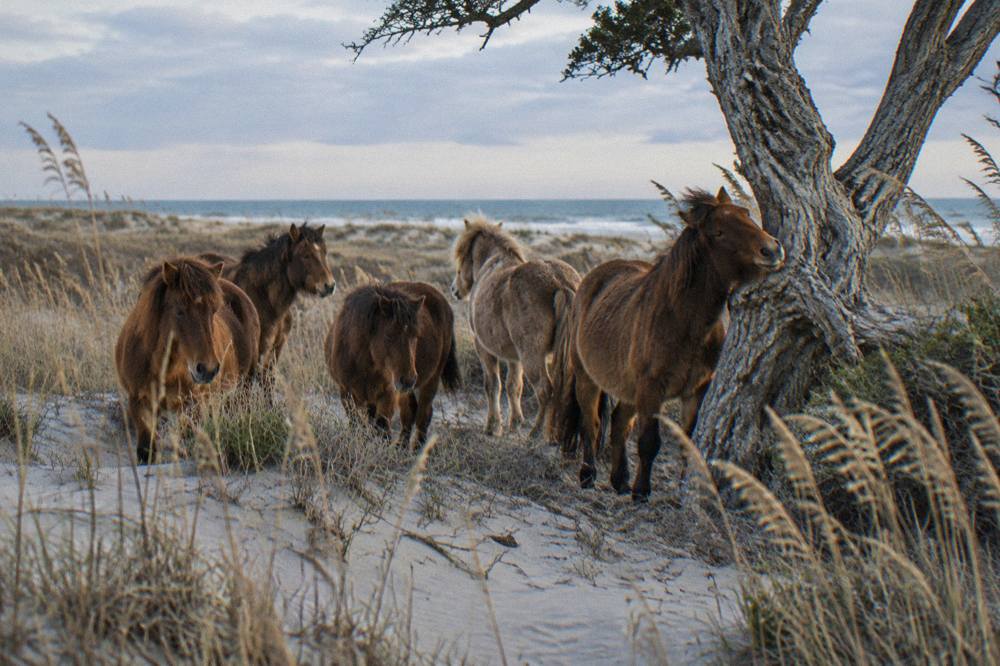
The Fund's management approach reflects how closely it watches the population without interfering with the horses' wild status. Because the animals are identified visually, a horse with a particular blaze or sock pattern can be followed year over year, and the aerial counts by helicopter give the County's Wild Horse Advisory Board a defensible number rather than a guess. Reproduction is managed with PZP, an immunocontraceptive the Fund uses to keep the herd within the carrying capacity of its acreage, a practice that has replaced the older and far grimmer alternative of removal.
Currituck County adds its own layer of protection on top of the Fund's work. The County's wild horse ordinance makes feeding the horses or coming within 50 feet of them punishable by law, and tour operators face their own rules: tour vehicles must display a valid North Carolina license tag and County-issued yearly identification, must stay at least 50 feet from the horses, and may only run west of the dune line in the four-wheel-drive area between 8 a.m. and 8 p.m., with amplified sound banned there at all times. The County spells these rules out on its horse tours page at Currituck County's official horse tours guidance.
For visitors, that regulation is the quiet reason a guided tour works so well here. The 2-hour open-air 4WD truck tour is driven by operators licensed under exactly those County rules, with a guide who knows the bands' territories and can read the animals from a legal distance. You can read more about the logistics in the driving versus guided tour comparison.
Why The Herd Lives North Of The Paved Road
The horses frequenting Corolla were moved north of the paved road after eleven of them were struck and killed on Highway 12 between 1985, when the road between Duck and Corolla was paved, and 1989, the year the Corolla Wild Horse Fund was organized. A fence now runs along the northern edge of the paved area, and the herd's range extends approximately eleven miles north to the Virginia state line.
This is the part of the story most visitors never hear, and it explains almost everything about where the horses are today. Before the road was paved, horses wandered across the whole village area of Corolla. Paving brought faster traffic, and fast traffic killed horses. Eleven deaths in four years prompted the response: the Fund was organized in 1989, incorporated as a 501(c)(3) in 2001, and the horses were relocated north of the paved road into what locals call the north beach or the 4x4 area.
| Year or period | What happened | Why it matters to the herd |
|---|---|---|
| Spanish colonial era | Spanish horses arrive in the Southeast | Ancestral stock of today's Colonial Spanish Mustangs |
| 1985 | Highway 12 between Duck and Corolla is paved | Faster traffic reaches horse territory |
| 1985 to 1989 | Eleven horses are struck and killed on Highway 12 | Sparks the organized protection effort |
| 1989 | Corolla Wild Horse Fund is organized | Local advocacy becomes structured management |
| 2001 | The Fund incorporates as a 501(c)(3) | Permanent nonprofit stewardship of the herd |
| 2010 | State adopts the Colonial Spanish Mustang as Official Horse of North Carolina | Legal recognition of the lineage |
The geography that resulted is unusual. The beach north of the paved road is considered public road and is open to the public; it is the only access for residents and guests staying in Carova, North Swan Beach, and Swan Beach. Of the 7,544 acres accessible to the horses, the Fund describes the land as a mix of 70 percent private and 30 percent public use, with 3,150 platted lots and only a quarter of the northern beaches currently developed. The horses share all of it with houses, trucks, and beach umbrellas, which is why the etiquette rules matter so much. The 50-foot rule and etiquette guide covers exactly what a visitor should do when a horse walks toward them: the responsibility to stay 50 feet away stays with the person, not the horse.
It also explains why the horses are so consistently findable by tour trucks but not from the paved village. North of the fence there are no paved streets, no through traffic except 4WD vehicles on the sand, and a habitat the bands know intimately. A guide who runs that beach daily is working with animals whose home territories the Fund has mapped by observation over years.
How The Herd Is Doing Right Now
The 2026 season brought at least twelve healthy foals, seven fillies and five colts, with the Fund noting one or two more could still arrive before the season closes, and the herd's seasonal movements follow a predictable pattern driven by insects and heat rather than random wandering. Biting flies in spring and heat stress in summer push the horses out of cover and onto the open beach.
Fresh reporting from the herd's range fills in the picture the history books cannot. Four healthy foals, three fillies and one colt, were spotted roaming free in Corolla by late April 2026, and by late summer the count had reached twelve. The previous year ended with a surprise foal marking the tenth birth of 2025. Foals are fragile in more ways than one: the Fund has stressed that getting too close causes stress and may separate foals from their mothers, and its educational material notes that foals are extremely impressionable and must not become too accustomed to humans in their first months.
The pattern matters for anyone planning a trip. The horses are not multiplying into every yard in town, they are relocating in response to conditions that repeat every summer. In April, biting flies and shifting winds push them out of secluded areas and onto the sand, drawing crowds near the southern barrier fence. Through the summer, heat does what the insects did earlier: forcing horses out of cover and into the open, where the ocean breeze offers relief. The best time of day to see the horses follows the same logic, because the animals move with comfort, not with a schedule.
The Fund's own calendar fills out the visitor side of its mission. In 2026 its Mustang Mornings program opened the Betsy Dowdy Equine Center in Grandy to the public on Wednesdays from May 27 through August 26, 9 a.m. to 1 p.m., with a suggested donation of $10 per vehicle at the gate and a free screening of The Secret of Corolla, a 32-minute documentary. The Fund's museum and gift shop in Corolla village keeps seasonal hours. Details for both are on the Fund museum and Mustang Mornings page, and the Fund's own herd management page at corollawildhorses.com is the primary source for management facts.
Is The Origin Story Settled?
Not entirely. The Colonial Spanish lineage is accepted by the Fund and the state, but the specific mechanism, shipwreck, abandonment, or gradual dispersal from failed Spanish settlements, is not documented in any surviving record. The Fund and reputable summaries present the lineage as fact and the arrival story as informed theory, and honest coverage keeps the two separate.
The shipwreck version is the one told on porches and in brochures: a Spanish galleon runs aground on the shoals, the crew swims ashore, and the horses swim with them. It is a good story and it is plausibly true in at least some form, because the Outer Banks' shoals genuinely wrecked Spanish shipping and Spanish expeditions genuinely lost horses in the Southeast. What it lacks is a primary document naming a wreck and a herd.
The competing account is quieter but no less dramatic. Spanish expeditions in the colonial era left horses at temporary settlements and failed colonies along the coast, and animals that escaped or were abandoned formed free-ranging populations that drifted into the barrier islands over generations. The full history of the Corolla wild horses walks through both threads.
What tips the evidence toward Spanish ancestry is the horses themselves. The phenotype, the compact build, the gait, the coat patterns, and the hardiness, matches Colonial Spanish strains found in other remnant coastal herds, and the state's 2010 designation codified that consensus. The Fund states the lineage plainly on its history pages at the Fund's own history of the herd. A careful visitor should feel confident saying "these are descendants of Spanish colonial horses" and should stop short of saying "these came off the shipwreck of such-and-such a year," because nobody can.
Seeing The Descendants On A Corolla Horse Tour
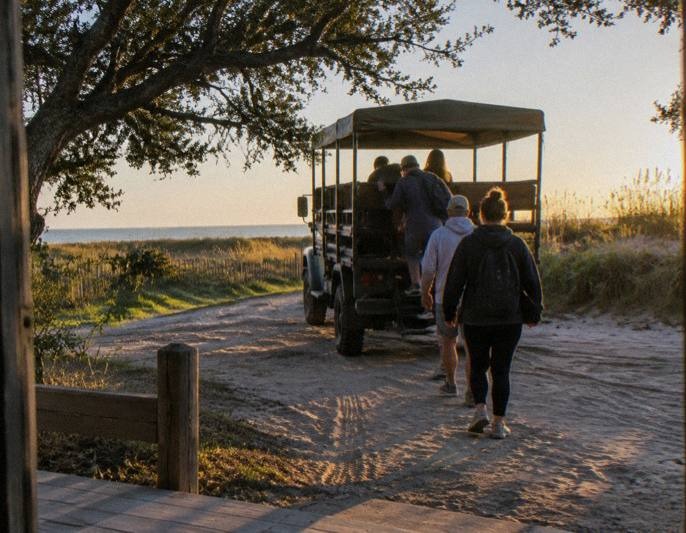
The 2-hour Outer Banks Wild Horse Tour by 4WD Truck, rated 4.8 across 2,871 reviews and listed from $65 per person, takes up to 12 travelers in an open-air four-wheel-drive truck along the herd's actual range north of the paved road. It meets at 1148 Ocean Trail in Corolla, and the booking page shows the live price and current dates.
This is where the origin story stops being abstract. The horses the Spanish stock became are standing on a beach you can reach, but only with a four-wheel-drive vehicle, because the refuge and beach north of Corolla are accessible by 4WD or boat only, as the U.S. Fish and Wildlife Service states for the Currituck National Wildlife Refuge that occupies part of the range. The guided truck tour handles that obstacle for you, with a driver who knows the sand and a guide who knows the horses.
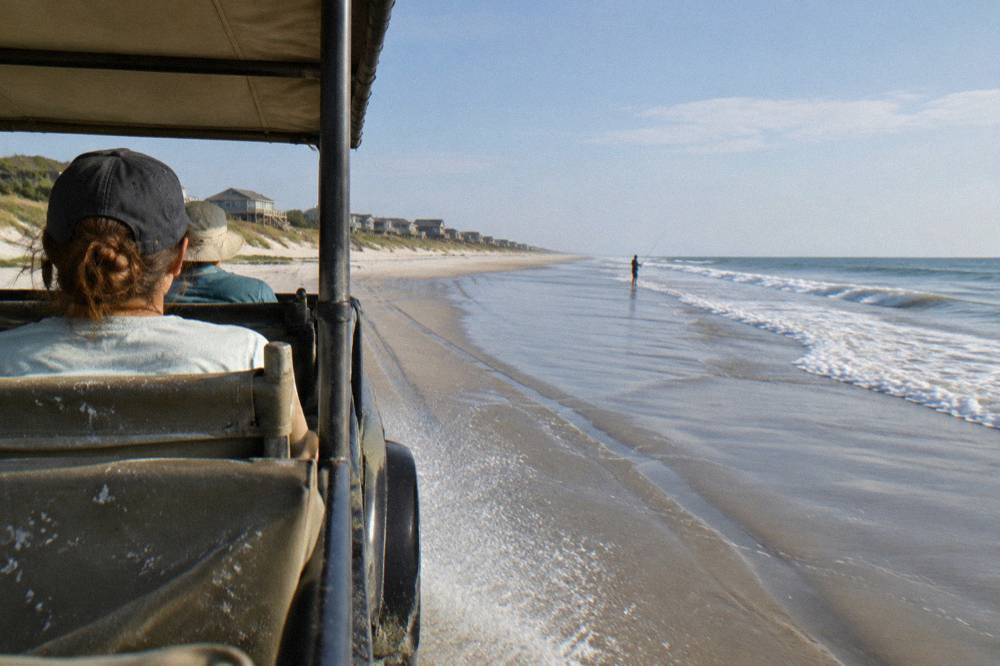
A few practical notes from the listing itself: the tour lasts about two hours, food, drinks, and hotel pickup are not included, it is not wheelchair accessible, moderate physical fitness is recommended, and children under five years or 40 pounds cannot be accommodated. Travelers with back problems are advised against it, since the beach ride is genuinely bouncy, a point covered in more depth in the bumpiness and accessibility guide. Families weighing the minimums can check the horse tours with kids guide for the age and fit questions that come up most.
| Question | What the record and the listing say |
|---|---|
| Are they Spanish? | Recognized as Colonial Spanish Mustangs; State Horse of North Carolina since 2010 |
| Was there a shipwreck? | Plausible, but no primary document confirms a specific wreck |
| Why are they north of Corolla village? | Moved after eleven horses were killed on Highway 12 between 1985 and 1989 |
| How big is their range? | 7,544 acres, roughly 70 percent private and 30 percent public use land |
| How close can you get? | 50 feet, by county ordinance, on foot or in a vehicle |
| How do you see them? | A licensed 4WD tour, or your own four-wheel-drive vehicle on the beach |
The point of learning where the horses came from is that it changes what you are looking at. A band grazing behind a dune is not a photo prop; it is the tail end of a story measured in centuries that survived pavement, development, and hurricanes because a community decided, starting in 1989, that it should. The tour guide will point out which band you are watching and where its territory runs, and that context is the difference between a drive on the beach and an encounter with living history. The site, Corolla North Carolina Horse Tours, keeps a full rundown of the tour page for dates and booking.
Common Questions About The Outer Banks Wild Horses
How did wild horses get to the Outer Banks?
They are descendants of Colonial Spanish horses brought to the Americas during the Spanish colonial era. The state of North Carolina recognized the lineage in 2010 by naming the Colonial Spanish Mustang the Official Horse of the State. The exact arrival event, whether shipwreck, abandonment, or gradual dispersal, is not documented.
Are the Corolla horses really Spanish mustangs?
Yes, in the sense that matters. The Corolla Wild Horse Fund and the North Carolina General Assembly both recognize the herd as Colonial Spanish Mustangs, a remnant strain of early Iberian horses. The specific ship or settlement that brought them is unknown.
Why do the horses live only north of Corolla?
After Highway 12 between Duck and Corolla was paved in 1985, eleven horses were struck and killed on the road by 1989. The horses were moved north of the paved road, and a fence now keeps the herd on the roughly eleven miles of beach and land between Corolla and the Virginia line.
How many wild horses live on Corolla beach?
The Fund counts the herd by helicopter survey and reports to the County's Wild Horse Advisory Board, with as many as six aerial counts a year. The Fund does not publish a current head count on its public pages, so no exact number is given here.
Can you touch or feed the wild horses?
No. Currituck County's wild horse ordinance makes feeding the horses or coming within 50 feet of them punishable by law, and on the Currituck National Wildlife Refuge it is unlawful to harm, approach, or feed any wild horse. Licensed tour vehicles must keep the same 50-foot distance.
What is the best way to see them?
A licensed guided 4WD tour, such as the 2-hour open-air truck tour rated 4.8 across 2,871 reviews and listed from $65 per person, or your own four-wheel-drive vehicle driven carefully on the beach north of the paved end of NC-12, keeping at least 50 feet from any horse.