Where To Find The Corolla Wild Horses Today
The Corolla wild horses roam 7,544 acres between the end of the paved road and the Virginia line, and no app, map or operator can tell you exactly where they are standing on any given morning. Here is what actually determines where the herd is, hour by hour and season by season.
Short answer
The Corolla wild horses live on 7,544 acres of the northern Outer Banks, from the terminus of paved NC-12 in Corolla roughly eleven miles north to the Virginia state line. Locating them on a given day depends on insects, heat, wind and tide, which is why a guided 4WD truck tour from $65 per person is the lower-risk way to a sighting.
The question every visitor asks on the drive north is the same: where are they right now? The honest answer is that the Corolla wild horses go where the conditions push them, across a range the Corolla Wild Horse Fund manages as 7,544 acres of mixed habitat north of the paved end of NC-12. That range includes roughly 700 houses, thousands of people and vehicles in summer, and a beach the Fund describes as public road, the only access for anyone staying in Carova, North Swan Beach and Swan Beach.
Nobody can hand you a pin on a map, and anyone who does is guessing. What you can do is understand the system: the geography that fences the herd in, the seasons that move it around, and the hours of the day when horses are most likely to be in the open. For many visitors that reasoning ends with a booked seat on a guided 4WD truck, because a driver who runs the beach twice a day holds better location intelligence than any static guide. You have two ways to see the horses: track them down on your own, or let a guided tour do the searching for you.
Where Do The Corolla Wild Horses Actually Live?
The herd lives on the northern Outer Banks beaches, on 7,544 acres the Corolla Wild Horse Fund manages between the northern edge of Corolla village and the Virginia state line, roughly eleven miles to the north. The paved road ends in Corolla; beyond that point the beach itself is the road, and four-wheel drive is required. The horses share this land with private homes, maritime forest and brackish marsh, moving freely across all of it.
The geography matters more than most first-time visitors expect. The Fund's herd-management page describes the acreage as a mix of 70 percent private land and 30 percent public use, with 3,150 platted lots of which only about a quarter are currently developed. In practice that means the horses are not confined to a park with boundaries and viewing areas. They wander through backyards, sand roads, marsh edges and the foreshore, sometimes within sight of a rental house deck and sometimes a mile deep in thicket where nothing on wheels can follow.
| Fact about the range | What the sources say |
|---|---|
| Total habitat | 7,544 acres managed by the Corolla Wild Horse Fund |
| Northern boundary | Approximately eleven miles north, at the Virginia state line |
| Southern boundary | A fence at the end of the paved portion of NC-12 in Corolla |
| Land mix | 70 percent private, 30 percent public use |
| Development | 3,150 platted lots, about 25 percent developed |
| Access beyond the pavement | The beach is considered public road; four-wheel drive is required |
The southern fence is the reason the horses are here at all in their present numbers. The Fund's history pages record that eleven horses were hit and killed on Highway 12 between 1985, when the road between Duck and Corolla was paved, and 1989, when the Fund was organized. The horses frequenting the village were then moved north of the paved road to what locals call the north beach or the 4x4 area, and a fence now keeps the herd on the sand roads and beaches north of it. Everything in this article happens north of that fence. If you are standing on a Corolla village beach south of the pavement, you are outside the herd's range, and no amount of patience will change that.
North of the fence, the land changes character quickly. The Currituck National Wildlife Refuge, administered by the US Fish and Wildlife Service, encompasses maritime forest and brackish marsh north of the town across six units between Corolla and the state line, with the first refuge tract roughly three quarters of a mile north of the pavement. The refuge's own pages note that it has no developed public facilities, no roads, no trails and no restrooms, and that vehicle traffic is restricted to the beachfront. The horses use this ground freely, which is one more reason a sighting can never be scheduled like a train arrival.
Where Are The Corolla Horses Today?
Nobody can answer that question with an address, on any day, and any page or parking-lot tip promising a fixed location is guessing. The horses are wild, they move in response to insects, heat, wind and forage, and they do so across eleven miles of beach and interior sand roads. What you can rely on is pattern: the herd's behavior repeats seasonally and predictably, even when individual bands are unpredictable.
This is the single most useful thing to understand before you plan a day around a sighting. A tour truck that left at 8 a.m. may have found horses two miles up the beach; a truck leaving at noon the same day may find the same bands half a mile further north, moved by an afternoon sea breeze carrying biting flies inland. Fresh reporting from the 2026 season put it plainly: the horses are not multiplying, they are relocating, seasonally and predictably, in response to conditions that repeat every summer. The same reporting noted that by late summer the herd had welcomed at least twelve healthy foals in 2026, seven fillies and five colts, which changes band behavior too, since mothers with new foals hold different territory than bachelor groups.
The Fund's position on approach distances shapes where you can look, not just how. Currituck County's wild horse ordinance makes it illegal to come within 50 feet of a wild horse, and the Fund's ordinances page states plainly that feeding the horses or getting within 50 feet of them is punishable by law, regardless of a person's experience with horses. If horses approach you on the beach, the Fund's FAQ says it remains your responsibility to stay at least 50 feet away. Practically, that means the long lens and the distant silhouette are the honest self-drive sighting, and anything closer belongs to a licensed tour vehicle whose drivers are trained and permitted to manage the interaction.
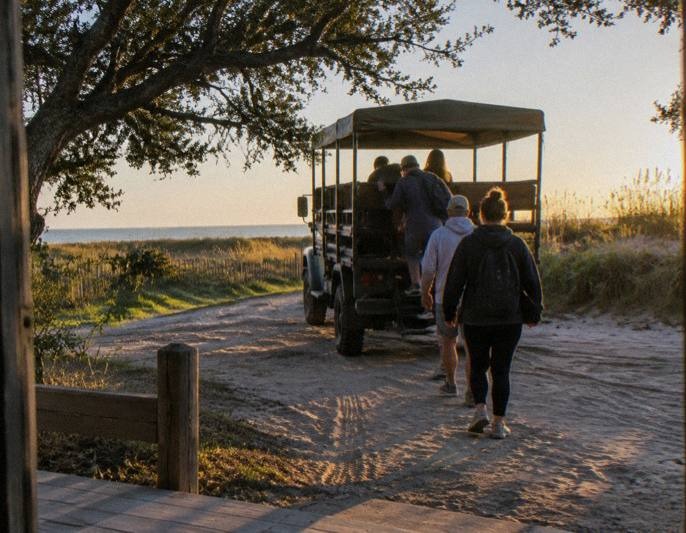
That constraint is why the guided option earns its price for so many visitors. The featured 2-hour Outer Banks Wild Horse Tour by 4WD Truck, rated 4.8 across 2,871 reviews and listed from $65 per person, puts a guide who drives this beach daily between you and the guessing. The listing describes transport by open-air four-wheel-drive truck with no ATVs, a maximum of 12 travelers, and a meeting point at 1148 Ocean Trail in Corolla. You can read the full details and see the tour page for the 2-hour 4WD wild horse tour before deciding, or compare it against the self-drive route in the guide to seeing the horses without a tour.
There is one more honest limit worth stating: even the tours describe sightings as likely, never certain. The horses roam the whole acreage, weather moves them, and any operator who promises a specific animal at a specific spot is selling something the biology does not support. What a tour does promise is that the search happens from the right vehicle, with someone whose job is to find them, inside the county's rules for licensed tour vehicles, which include staying at least 50 feet from the horses and operating only between 8 a.m. and 8 p.m. west of the dune line.

What Beach Has The Most Wild Horses?
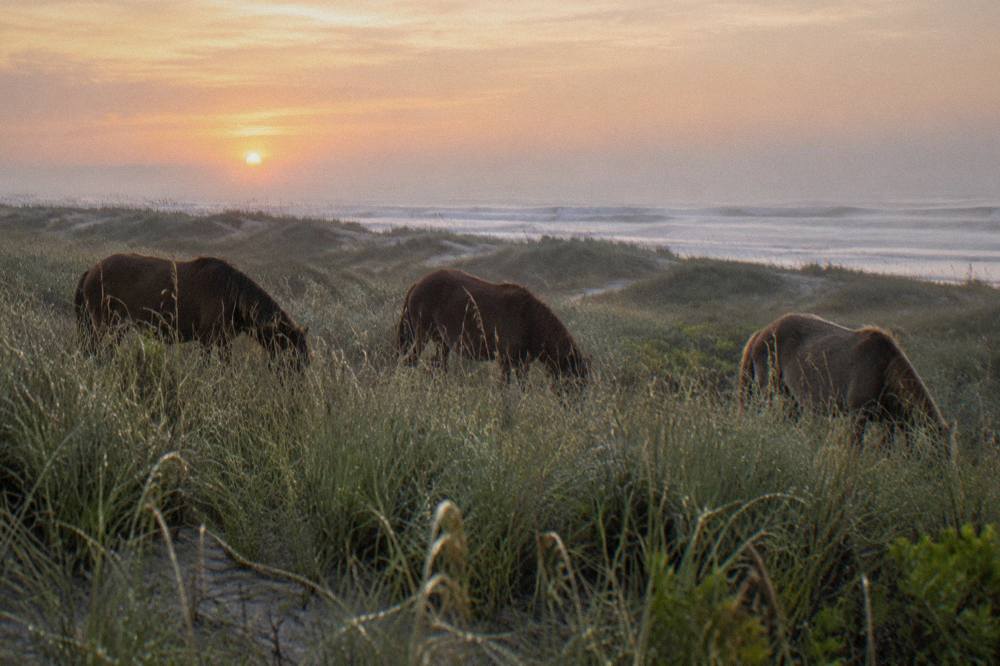
No single beach holds the most horses year-round, but the open sand between the dune line and the water concentrates sightings in spring and summer, because biting flies and then heat push the herd out of the interior thickets. In April 2026, flies and shifting winds moved horses onto the beach in visible numbers, and the pattern held through summer as heat stress did the same work the insects had done earlier.
The sequence is worth learning because it tells you where to point the car. In early spring the horses spread through the maritime forest and the sand roads behind the dunes, browsing new growth. When the biting insects arrive, the beach becomes the relief zone: wind and open sand mean fewer flies, so bands shift to the foreshore, especially near the southern barrier fence where crowds tend to gather. Through the hottest weeks, heat stress keeps them in the open and near the water in the middle parts of the day, then reverses the pattern toward evening shade. Fresh coverage of the 2026 season described exactly this repeatable relocation, and noted the added draw of crowded viewing near the fence line whenever bands settle within sight of the paved-accessible beach.
| Season | Where the herd tends to be | Why |
|---|---|---|
| Spring | Moving out of the thickets onto open beach | Biting flies and shifting winds drive them from cover |
| Early summer | Foreshore and dune-line shade, marsh edges | Heat stress favors open wind and water proximity |
| Late summer | Open beach in mornings and evenings, shade midday | Foal-raising bands hold territory near reliable forage |
| Fall and winter | Scattered wider across the interior roads | Insect and heat pressure fades; fewer people on the beach |
Two cautions follow from this table. First, the crowded spot is not always the good spot: the Fund has repeatedly stressed that getting too close stresses the horses and can separate foals from their mothers, and a beach full of people pressing toward one band is exactly the wrong scene. Second, the seasonal pattern describes probabilities, not appointments. A day of hard north wind in July can push a band back into the thicket for 48 hours, and a mild overcast October afternoon can produce a sighting on the sand road behind the houses when nobody expected one.
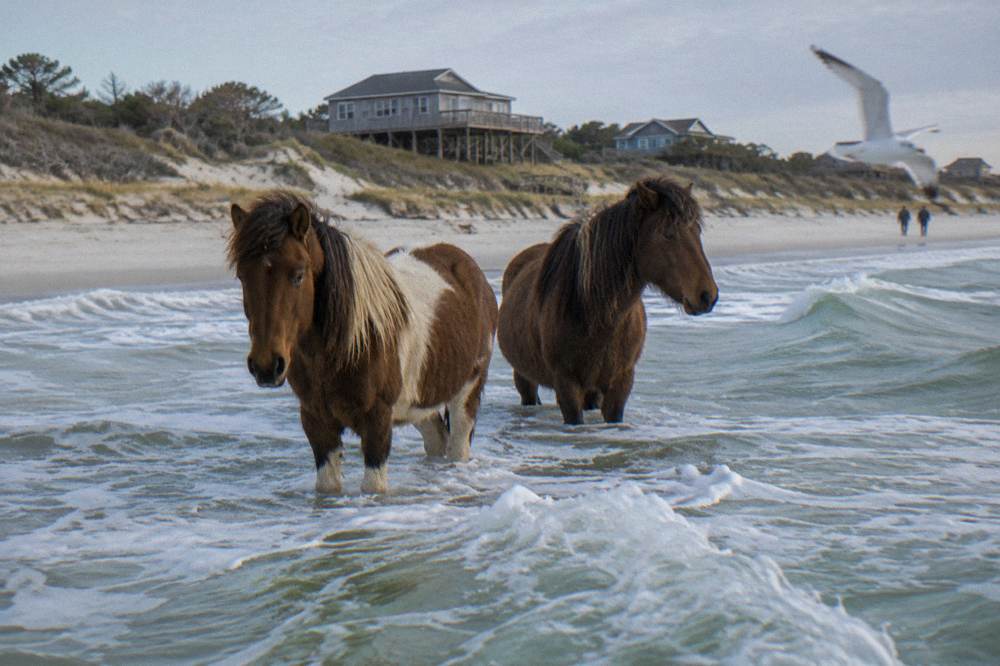
For visitors who want the sighting but not the uncertainty, this is the decision point where a booked seat makes sense, and the comparison of the best time of day to see the Corolla wild horses pairs well with it. The featured Corolla horse tour runs the off-road beaches in the open-air truck with a guide who tracks these seasonal movements professionally; the tour roster lists it at 4.8 across 2,871 reviews, from $65 per person, roughly two hours on the sand.
Can You Find The Horses On Your Own From The Paved Area?
You cannot reach the herd's core range on regular pavement, because the range begins where the road ends. North of Corolla village the beach is the road, the US Fish and Wildlife Service states plainly that four-wheel drive is required at the NC-12 terminus, and refuge access is by 4WD vehicle or boat only. From the paved-accessible beaches you may spot horses near the fence, but the odds are modest.
Driving yourself is simple in principle: NC Route 12 ends in Corolla and traffic diverts onto the sand, where four-wheel drive is required. See driving the Corolla 4x4 beach yourself versus a guided tour before you try it. County guidance asks drivers to use four-wheel drive when entering the ramp and to maintain a slow, steady speed, and to stay off the sand entirely without proper equipment. The refuge's visitor information page confirms the same from the federal side: follow NC-12 north to its terminus in Corolla, where traffic is diverted onto the beach and four-wheel drive is required.
What the self-driver gains in freedom, they trade in search efficiency. The range is eleven miles of beach plus a web of interior sand roads on private land, and a first-time visitor in a rental 4x4 has two hours of guesswork ahead of them, plus the 50-foot rule to respect the whole time. The tour trucks, by contrast, relay sightings between drivers over the course of a day, which is precisely the intelligence an independent driver cannot buy. For a family with one afternoon in Corolla, that difference is the whole argument, and it is why we compared the two options honestly rather than pretending the self-drive route is easy.
| Search method | Reach | Best for | Main limit |
|---|---|---|---|
| Walk or watch from paved-accessible beach near the fence | Southern edge of the range only | Free, zero-planning stops | Low odds; horses may be miles north |
| Drive your own 4x4 on the beach | Full eleven-mile beach and public sand roads | Independent travelers with proper vehicle | No sighting intelligence; rules apply to you |
| Guided open-air 4WD truck tour | Full range with a daily tracker | Visitors wanting the best odds in fixed time | Booked seat, scheduled departure |
| Fund museum and gift shop | Fixed location in Corolla village | History, context, guaranteed something to see | No live wild horses on site |
Why The Museum Is The One Fixed Stop On Any Horse Day
The Corolla Wild Horse Fund's museum and gift shop at 1130E Corolla Village Road is the only horse-related stop in Corolla that is always where you left it. It is open seasonally Tuesday through Saturday, 10 a.m. to 4 p.m., closed Sunday and Monday, and it is the place to learn the herd's history, ask staff where horses have been reported, and support the nonprofit that manages the herd.
The museum does not display live wild horses, and it is important not to expect that. What it offers is certainty on a day built around an uncertain animal: exhibits on the Colonial Spanish Mustang, which the North Carolina General Assembly adopted as the Official Horse of the State of North Carolina in June 2010, the story of the fence and the Fund's work since 1989, and staff who field sighting questions all day long. The Fund does not publish admission prices, so call ahead before visiting; the phone number is (252) 453-8002.
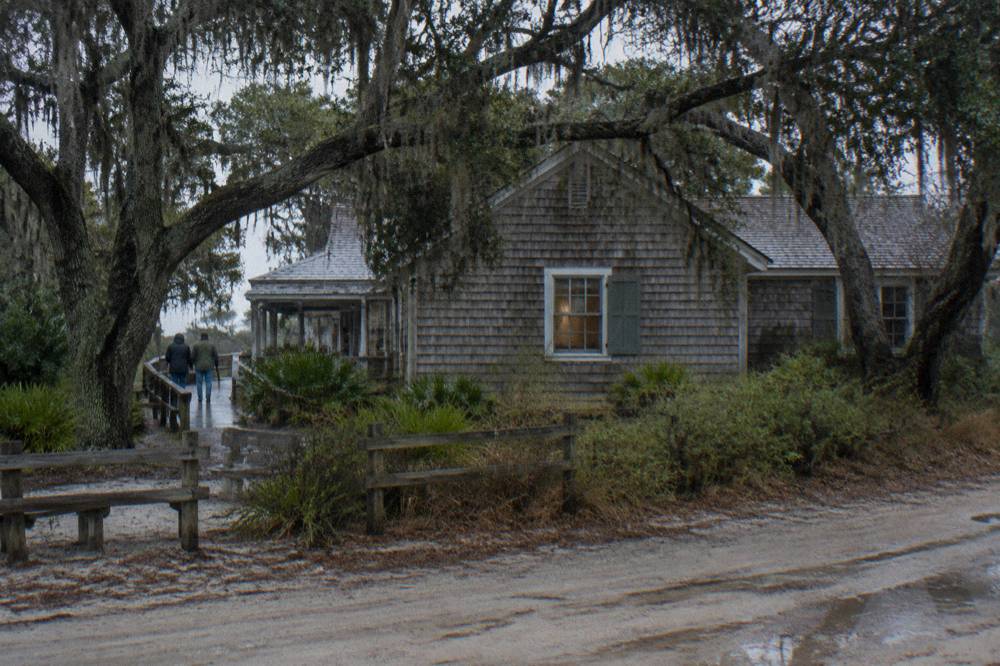
The Fund's mainland presence is the other fixed point, though it is a drive away. In 2026 the Mustang Mornings program ran on Wednesdays from May 27 to August 26, opening the Betsy Dowdy Equine Center in Grandy to the public from 9 a.m. to 1 p.m. with a suggested donation of $10 per vehicle at the gate, including a free screening of The Secret of Corolla, a 32-minute documentary. That season has ended, and the farm is otherwise closed to visitors outside scheduled events, so check the Fund's calendar for the next opening rather than planning around a Wednesday. The full program is described in our guide to the Fund museum and Mustang Mornings.
Pairing the museum with a tour works well as a day shape. The museum visit is guaranteed, takes under an hour, and gives the herd's story a frame; the 4WD truck tour, departing from 1148 Ocean Trail a short drive away, is the part that goes looking for the living animals. Visitors who do both consistently report the combination feels complete in a way the tour alone does not, because the history explains what you are looking at when a band finally crosses the sand in front of the truck.
How Foals And Fresh Herd News Change The Search
The 2026 season brought at least twelve healthy foals, seven fillies and five colts, and the Fund noted one or two more could still arrive before the season closed. Foal presence changes where bands go, because mothers with young keep to reliable forage and shade, and the Fund has asked the public for extra distance precisely because foals are extremely impressionable in their first months.
The Fund's educational update on horses approaching people made the point bluntly: foals must not become too accustomed to humans in these first months, which is a behavioral reason for the 50-foot rule beyond the legal one. A foal that learns to associate people with food or attention is a foal that walks toward cars, and the 2026 reporting recorded a foal on Corolla Beach becoming entangled in old fencing in June, a reminder that this landscape is not a petting zoo with hazards removed. The same reporting noted four horses struck by vehicles in 2025, two of them fatally, which is why county guidance on slow, steady beach driving is written the way it is.
| 2026 herd item | What was reported | Why it matters for location |
|---|---|---|
| Foal count | At least twelve healthy foals, seven fillies and five colts | Nursing bands favor shade, forage and quiet territory |
| Spring movement | Flies and shifting winds pushed horses onto the beach in April | Best open-beach viewing begins with insect season |
| Summer pattern | Heat stress kept the herd in the open through midsummer | Midday beach sightings more likely than in spring |
| Public request | The Fund asked for extra distance around foals | Crowds near mother-foal bands are the problem to avoid |
For the visitor, the practical reading is this: a season with a strong foal crop tends to concentrate reliable sightings in the quieter stretches where family bands hold territory, while bachelor groups roam harder to predict. A guide who has watched those bands all season knows which sand road held the mothers yesterday. That is not a promise any operator can print, but it is the real difference between a tracker and a tourist, and it is the quiet argument for the guided 4WD truck over a self-directed search when the sighting matters to the trip.
Planning Your Search: A Quick Field Summary
Plan around three variables: where the pavement ends, when the insects and heat push horses into the open, and how much uncertainty your group can absorb. The range is fixed and well documented, the seasonal pattern is reliable, the daily location is not. Fill the uncertain middle with either a licensed guide in a 4WD truck or a flexible day built around the museum and the fence-line beach.
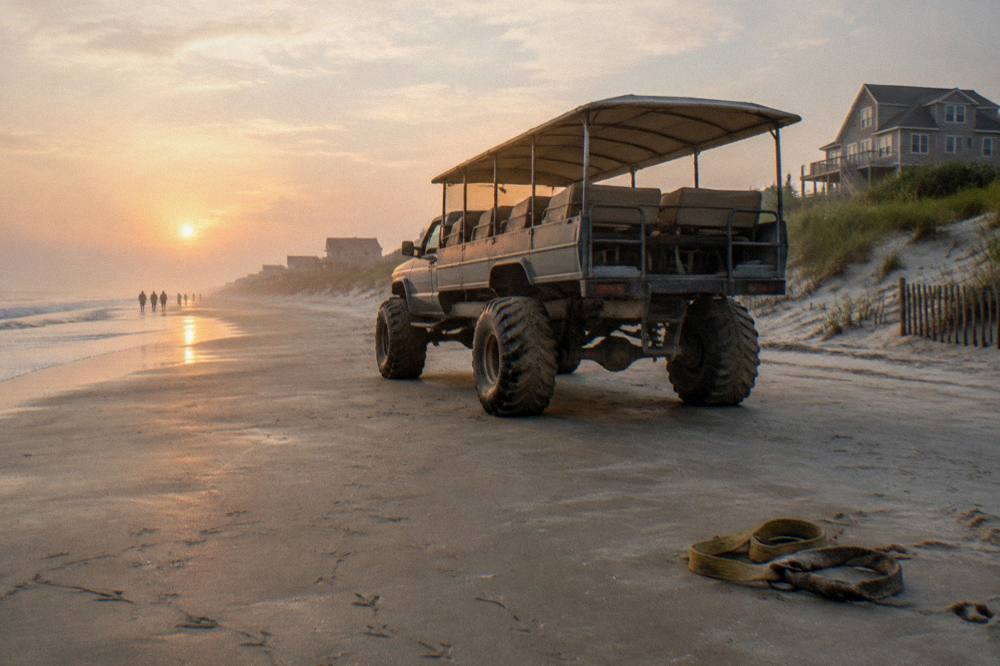
The featured tour fits most itineraries as the anchor booking: roughly two hours, from $65 per person as the roster lists it, departing from a parking lot shared with the Beer Garden in Corolla, with a maximum of 12 travelers per truck. The listing excludes food, drinks and hotel pickup, is not wheelchair accessible, is not recommended for travelers with back problems, and cannot accommodate children under five years or 40 pounds, so families with toddlers should check the age and weight terms before booking. If you want the deeper comparison before committing, our write-up of whether Corolla wild horse tours are worth it walks the value question line by line, and Corolla North Carolina Horse Tours keeps the featured tour's live details on the homepage.
| Planning item | The short answer |
|---|---|
| Range of the herd | 7,544 acres from the end of paved NC-12 to the Virginia line, about eleven miles |
| Southern viewing without 4WD | Paved-accessible beach near the fence; modest odds |
| Self-drive requirement | Four-wheel drive required at the NC-12 terminus; slow, steady speed |
| Guided option | 2-hour open-air 4WD truck tour, 4.8 across 2,871 reviews, from $65 |
| Fixed stop | Fund museum and gift shop, Tuesday to Saturday, 10 a.m. to 4 p.m., seasonal |
| The one rule that follows you everywhere | Stay at least 50 feet from any wild horse; feeding and petting are unlawful |
Whichever way the day goes, keep expectations calibrated to the landscape rather than to a brochure. Some days the herd cooperates spectacularly; some days a band sits a mile deep in thicket and the best sighting is tracks crossing the sand road. The visitors who enjoy Corolla most are the ones who treat the museum as the certain stop, the tour as the best-odds search, and the wild horses as what they are: animals on an eleven-mile range that nobody schedules, on a beach that belongs to them.
Common Questions About Finding The Corolla Wild Horses
Where are the Corolla horses today?
Nobody can say with an address, on any given day. The herd moves across 7,544 acres between the end of paved NC-12 and the Virginia line in response to insects, heat, wind and forage. Licensed tour drivers who run the beach daily hold the best current knowledge of where bands have been, which is one reason a guided 4WD truck tour is the lower-risk path to a sighting.
Where to find the horses in Corolla?
Look north of the fence at the end of the paved road, either from the paved-accessible beach near that fence, from your own properly equipped 4x4 on the beach, or from a guided tour truck. South of the pavement, in the village beaches, you are outside the herd's range. The Fund's museum on Corolla Village Road is the one fixed stop for the herd's story.
What beach has the most wild horses?
No single beach holds the most year-round. In spring and summer, biting flies and then heat push the herd out of the interior thickets onto the open foreshore, so the sand between the dune line and the water concentrates sightings, often near the southern barrier fence. In the cooler months the horses scatter wider across the sand roads and maritime forest.
Can you see the Corolla wild horses without a tour?
Yes, with modest odds. You can watch from the paved-accessible beach near the northern fence for free, or drive the beach yourself with a proper four-wheel-drive vehicle. The trade-off is search efficiency: an independent visitor has no sighting intelligence, while a tour guide tracks the herd daily. Our longer guide on seeing the horses without a tour covers the details.
How close can you get to the Corolla wild horses?
Currituck County's wild horse ordinance makes it illegal to come within 50 feet of a wild horse, and feeding, petting or riding one is unlawful regardless of your experience with horses. If a horse approaches you, staying 50 feet away remains your responsibility. Licensed tour vehicles are held to the same distance rule.