Carova Beach: 4x4 Access Rules And What To Expect
North of Corolla the paved road simply stops, and the beach becomes the road. Here is what that means for access, rules, and seeing the wild horses.
Short answer
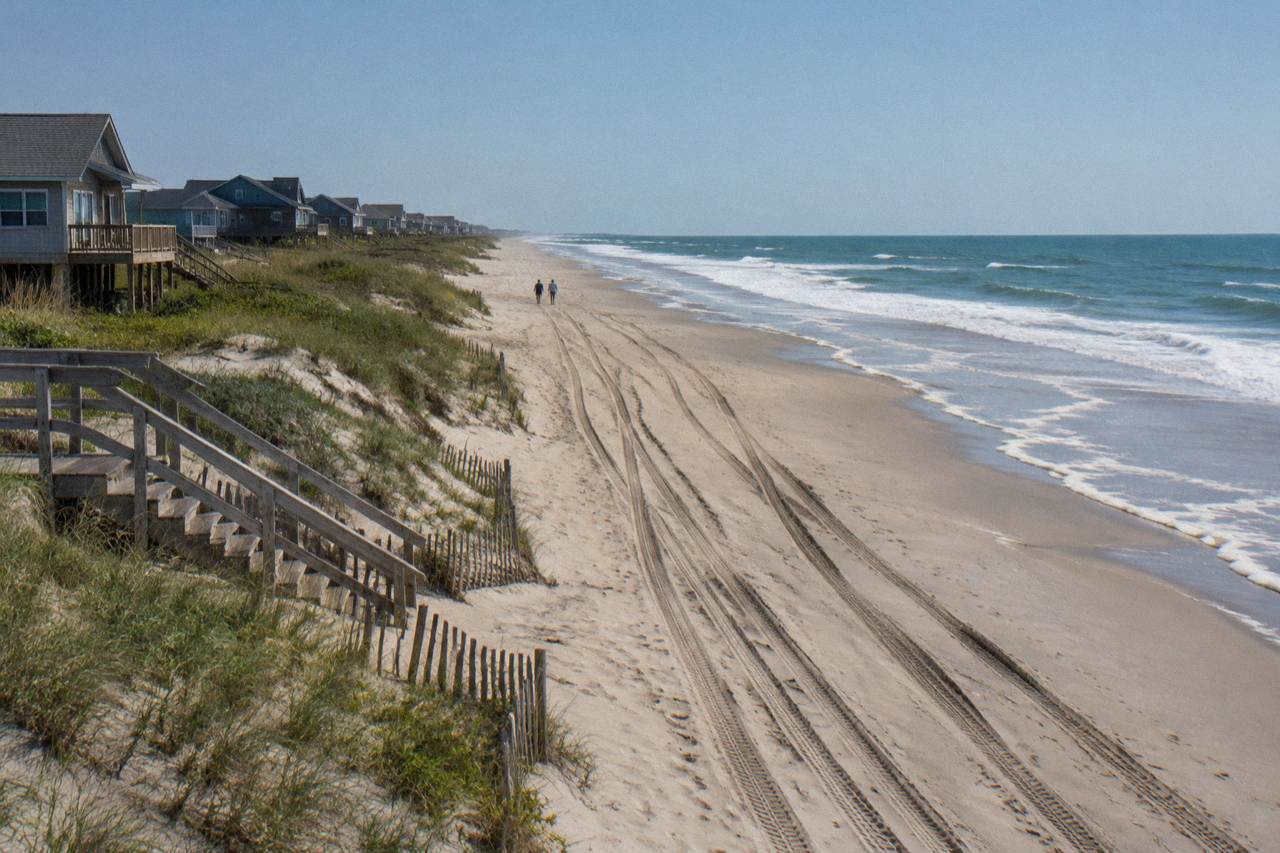
NC Route 12 ends in Corolla and traffic is diverted onto the beach, where four-wheel drive is required. The beach is a public road and the only access to Carova, North Swan Beach, and Swan Beach. Licensed tour vehicles operate west of the dune line between 8 a.m. and 8 p.m., and the featured 4WD truck tour runs from $65 per person.
Carova Beach sits at the very top of North Carolina's Outer Banks, past the last traffic light, past the last paved mile, past the last stretch of asphalt entirely. State Route 12 ends in Corolla and the beach itself becomes the road, a public road in the eyes of the county, running north along the ocean toward the Virginia line. The people who vacation in Carova, and the wild horses they share the peninsula with, are reachable only by sand. Before you point your wheels at the sand, check whether your vehicle can actually make the trip in our guide on whether a 4x4 is required to reach Carova Beach.
That single geographic fact shapes everything about visiting this stretch of coast. It is why the Corolla wild horses still roam free across 7,544 acres, why tour companies run open-air trucks instead of vans, and why every year some drivers in two-wheel-drive sedans get stuck within sight of the pavement. This guide lays out the access rules as the county, the Corolla Wild Horse Fund, and the U.S. Fish and Wildlife Service state them, and it explains the practical choice every visitor faces: drive the beach yourself, or ride in with a licensed guide on the 2-hour Outer Banks Wild Horse Tour by 4WD Truck. If you're still fuzzy on where the pavement ends and the sand begins, our guide to the off-road area north of Corolla explains the boundaries and the rules that apply once you're on the beach.
What Is The 4x4 Area North Of Corolla?
The 4x4 area is the roughly eleven-mile stretch of beach and back-lot land between the end of the paved road in Corolla and the Virginia state line, reachable only by four-wheel-drive vehicle or boat, where the wild horse herd lives among private homes on 7,544 acres of mixed habitat. The Corolla Wild Horse Fund describes the range as roughly 70 percent private land and 30 percent public use, with about 700 houses standing within it.
The boundary is a fence, not a gate. The Fund's history pages explain that the herd was moved north of the paved road after eleven horses were struck and killed on Highway 12 between 1985, when the road between Duck and Corolla was paved, and 1989. A fence now keeps the horses on the northern beaches, and everything north of it operates differently from the rest of the Outer Banks: no paved roads, no state maintenance, sand as the only thoroughfare.
The names on the map inside the area are Carova, North Swan Beach, and Swan Beach. The Fund notes that the beach is the only access for residents and their guests staying in those communities, which is why the county treats it as a public road with rules attached rather than as vacant shoreline. Visitors drive it too, and the same expectations apply to everyone.
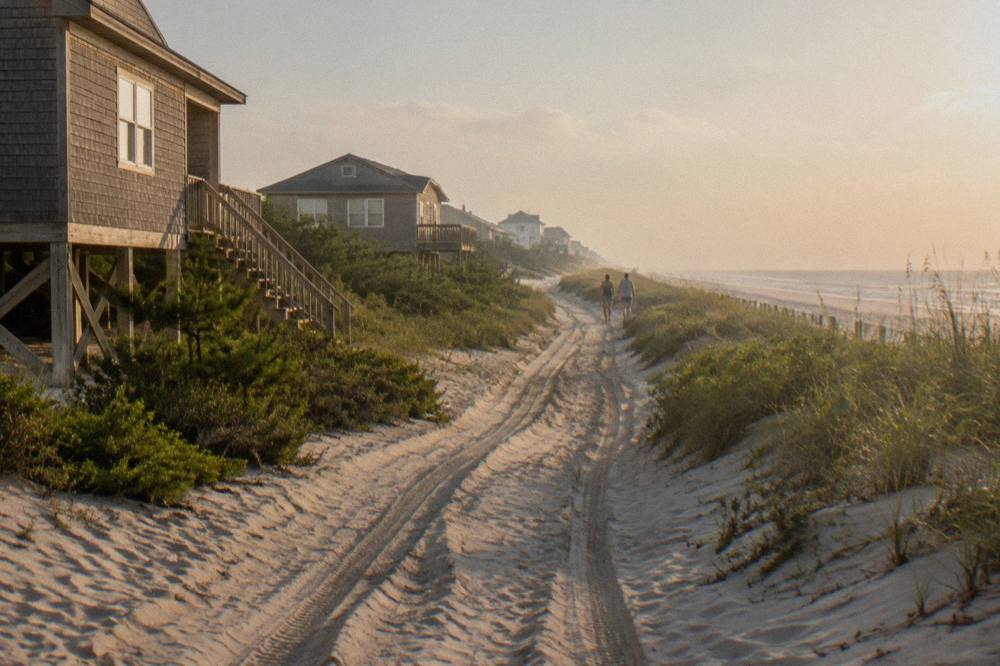
It is worth separating two things that get conflated. The beach is a travel corridor, open to properly equipped vehicles, and it is also habitat. The horses cross it, graze along it, and stand in the shallows on hot afternoons, and the rules that govern the whole area, from the 50-foot distance rule to the ban on feeding, exist because people and horses share one narrow ribbon of sand. If you are planning to spend time around the horses rather than just pass through, the Corolla wild horse 50-foot rule and etiquette guide covers those obligations in detail.
Do You Need Four-Wheel Drive To Reach Carova?
Yes. The U.S. Fish and Wildlife Service states plainly that Route 12 ends at its terminus in Corolla, traffic is diverted onto the beach, and four-wheel drive is required; the refuge lands beyond are accessible by 4WD vehicle or boat only. County guidance adds that drivers should engage 4WD when entering the ramp, maintain a slow steady speed, and not attempt the beach without it.
There is no alternative road, no shuttle, no parking lot at the fence line where you can walk the rest of the way in at scale. All-wheel drive is not the same as four-wheel drive with low range, and rental car agreements very often prohibit beach driving outright even when the vehicle is technically capable. The cars you see excavated from the sand every summer afternoon are usually the ones whose drivers treated the ramp like a hard road.
No official county or state source publishes a numeric beach speed limit, a required permit, or an access fee for visitors. The admission details are not listed here, since no official fee schedule is published. Check with the tour provider directly for current pricing before you go. What can be said with confidence: county guidance asks drivers to keep a slow, steady speed, and the beach is a public road where ordinary traffic law and courtesy both apply.
| Access question | The answer |
|---|---|
| Where does the paved road end? | At the NC-12 terminus in Corolla; traffic is diverted onto the beach |
| Is 4WD required? | Yes, per the U.S. Fish and Wildlife Service and county guidance |
| Is the beach a public road? | Yes, and the only access for Carova, North Swan Beach, and Swan Beach |
| Is a permit or fee required? | No official page states one; confirm with the county before your trip |
| Is there a speed limit to cite? | No number published; county guidance says slow and steady |
| Can you arrive by boat? | Yes, refuge and area access is by 4WD vehicle or boat only |
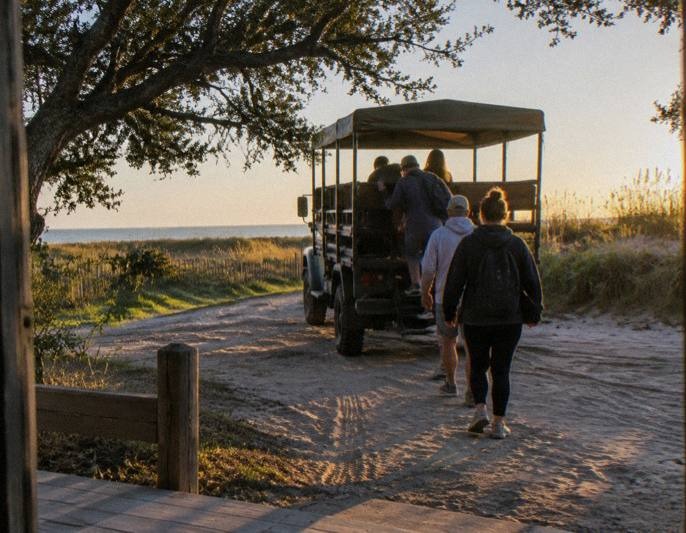
For travelers who read all of that and conclude that they would rather not drive it at all, that instinct is reasonable and it is the main reason guided tours exist. The featured Corolla horse tour, run with an open-air 4-wheel drive truck and a maximum of 12 travelers, puts a licensed commercial driver on the sand so you can watch the dunes instead of the tire ruts. It is rated 4.8 across 2,871 reviews and runs from $65 per person, with the booking page showing the live price for your date. If that framing fits your trip, the full details are on the tour page.
Can You Drive The Beach Yourself Instead Of Taking A Tour?
Yes, you can, if your vehicle has proper four-wheel drive and you accept the conditions: soft sand, shared right-of-way with the horse herd, no services once you leave the pavement, and county rules on speed and conduct that apply to every driver. It is a genuine option for confident beach drivers with the right vehicle and a willingness to air down and read the sand.
The county's own framing is worth internalizing: this is a road, and you are in traffic. On a busy July Saturday that traffic includes parked families, fishing lines, children at the waterline, and horses that have legally priority over none of it and physically occupy as much space as a truck. County guidance asks all drivers to keep a slow, steady speed the whole length of the beach, and tour vehicles, which are on that road all day every day, hold themselves to the same standard the county sets for them.
The self-drive route does have real advantages. You set your own schedule, you can carry beach gear that a tour truck will not hold, and you can stop where you like within the rules. The trade is that everything, from recovering a bogged vehicle to finding the horses in the first place, becomes your problem. The horses roam the full 7,544-acre range and move with the seasons, the insects, and the heat; a guide who drives the beach daily has a working sense of where the herd is this week, and a first-time visitor has tire tracks and luck.
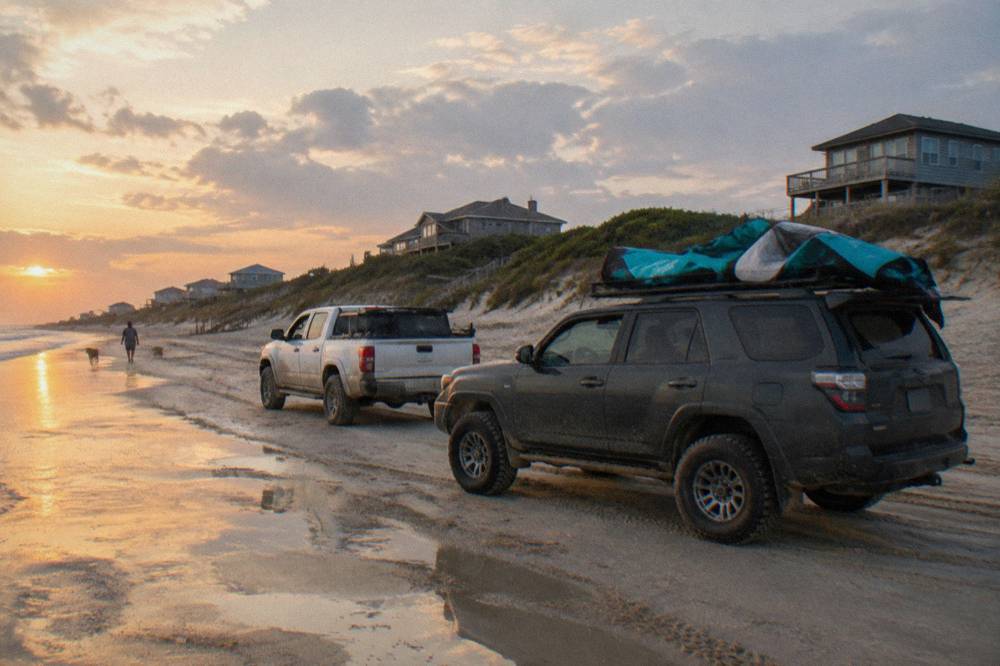
The driving the Corolla 4x4 beach yourself versus a guided tour comparison covers that decision in more depth, including vehicle preparation and what to do when you meet horses on the road. One point from the safety record deserves restating here: local reporting in 2026 noted that vehicles struck four horses during 2025, two of them fatally. Every driver on this beach is part of the herd's safety system, which is exactly why the county licenses and regulates the commercial vehicles too.
What Rules Apply To Tour Vehicles On The Carova Beach?
Currituck County requires tour vehicles to display a valid North Carolina license tag and the company name with a county-issued yearly identification, prohibits tour operation west of the dune line before 8 a.m. and after 8 p.m., bans amplified sound there at all times, and directs tour vehicles to stay at least 50 feet from the wild horses. Violations bring citations, and repeat citations can suspend an operator's license.
Those rules, published on the county's horse-tours page, are the practical proof that a licensed tour is not a free-for-all. The hours window exists because the beach is a shared corridor; the sound ban exists because the soundscape belongs to residents and wildlife; the 50-foot separation is the same distance the wild horse ordinance imposes on everyone. A licensed operator has a business reason to honor every one of them on every run.
| County rule for tour vehicles | What it means in practice |
|---|---|
| Valid NC license tag plus county yearly ID displayed | You can identify any legal tour truck at a glance |
| No tours west of the dune line before 8 a.m. or after 8 p.m. | Tour hours bracket the middle of the day, every day |
| No amplified sound west of the dune line, ever | Guides narrate at speaking volume |
| Tour vehicles stay at least 50 feet from wild horses | Same distance rule the ordinance sets for the public |
| Citations for violations; repeats can suspend the license | Enforcement is real and escalating |
The featured 4WD truck tour operates inside exactly this framework. The listing describes an open-air 4-wheel drive truck, no ATVs, with a friendly professional horse guide, departing from 1148 Ocean Trail in Corolla, sharing a parking lot with the Beer Garden. Maximum capacity is 12 travelers, food and hotel pickup are not included, and the tour is not recommended for travelers with back problems given the ride over uneven sand.
Would a guided seat remove the whole 4x4 question for your trip?
The 2-hour open-air truck tour includes cancellation flexibility on the booking page, so a weather change does not strand your money.
One more framing helps: the tour is not merely a workaround for lacking a 4x4. Plenty of guests arrive in capable trucks and still book the guided 2-hour ride for the guiding itself, because a guide who tracks the herd daily converts a scenic drive into an actual introduction to the horses, their history, and the management work behind the fence line.
Where Does The Road End And What Should You Expect At The Ramp?
The pavement ends at the NC-12 terminus in Corolla, where the U.S. Fish and Wildlife Service says traffic is diverted onto the beach; from that point north there are roughly eleven miles of sand and back-lot track to the Virginia line, with no fuel, no restrooms, and no services beyond what the private communities provide for their own guests.
Expectations matter more than equipment lists here. The ramp where pavement becomes sand is where the whole character of the drive changes: speeds drop, tire pressure matters, and the ocean becomes a neighbor rather than a view. County guidance is to enter in 4WD and stay slow and steady, which is less a suggestion than a description of the only way the surface permits travel in places.
Practical preparation is straightforward. Carry a shovel, a tow strap, and a tire gauge; know how to lower and reinflate your pressures; travel in daylight; and keep clear of the dune lines, which are both protected and the softest sand on the beach. No official source publishes a tide rule for beach drivers, but the strip of firm sand widens at low water, and a high tide with an onshore wind can pinch the passable lane badly. Confirm conditions locally on the day.
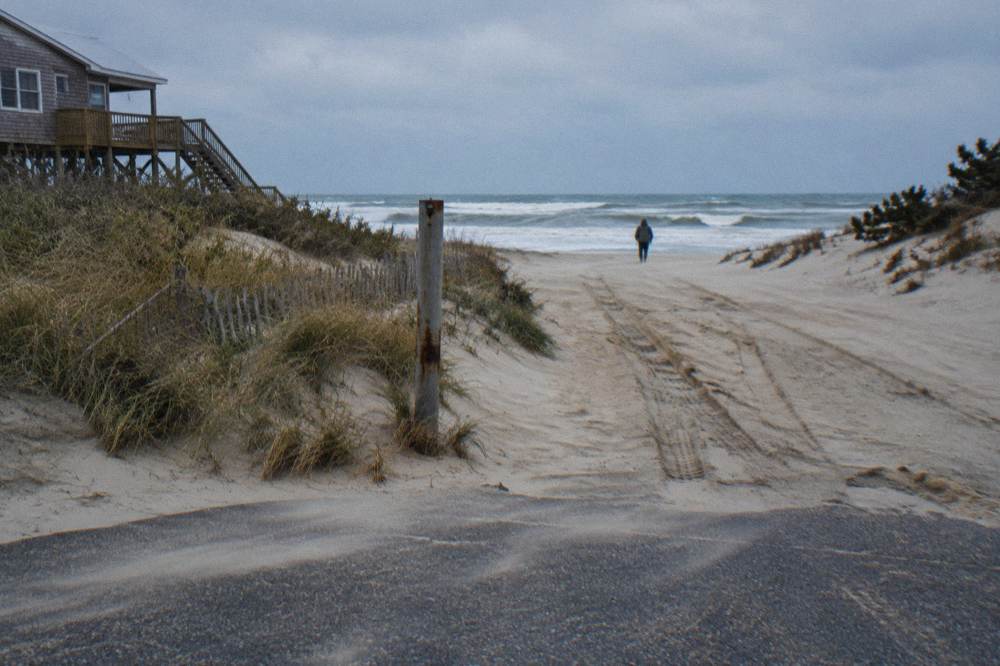
If you would rather engineer the whole question out of your itinerary, staying south of the terminus changes the math entirely. The where to stay in Corolla for wild horse tours guide maps the lodging clusters against the meeting point at 1148 Ocean Trail, which sits before the sand begins, so tour guests never drive the beach at all unless they choose to.

What About The Wildlife Refuge North Of Corolla?
The Currituck National Wildlife Refuge spans maritime forest and brackish marsh in six units between Corolla and the state line, is open daily from sunrise to sunset year-round, has no developed facilities, roads, trails, or restrooms, and is reached by 4WD vehicle or boat with traffic restricted to the beachfront. Federal rules make it unlawful to harm, approach, feed, or kill any wild horse on the refuge.
The refuge sits behind and among the private land of the 4x4 area, which confuses many first-time visitors. You do not drive into the refuge on an interior road, because none exist; the public parks on the beach and walks in, and the first refuge tract begins roughly three-quarters of a mile north of where the pavement ends. Everything the U.S. Fish and Wildlife Service publishes about it stresses self-sufficiency: no water, no waste disposal, no visitor station.
The federal wildlife rules matter to horse viewing because they layer on top of the county ordinance. Where the county makes coming within 50 feet of a wild horse unlawful and makes feeding, riding, or petting one punishable by law, the refuge side adds its own prohibition on approaching or feeding wildlife, including the horses. The agency describes the horses as viewed only from a distance, and its phrasing is a reminder that however tame the animals look standing beside a vacation rental, the law treats them as wild.
Is A Guided Corolla Horse Tour The Easier Way Into Carova?
For most visitors without a proper 4x4, yes: the 2-hour open-air 4WD truck tour delivers you into the 4x4 area with a licensed commercial driver, a guide who tracks the herd, and a from-price of $65 per person, all without touching a tire-pressure gauge or a tow strap. It is the one Corolla horse tour sold on a third-party booking platform with a live calendar and public reviews; the direct operators book on their own sites and by phone.
That last point is more practical than it sounds. The direct 4x4-area operators in Corolla sell their own seats by phone and their own booking pages, and on peak weeks those fill; the featured tour's live listing lets you lock a departure before you leave home, with cancellation terms stated on the booking page. The listing describes a roughly two-hour ride, rated 4.8 across 2,871 reviews, carrying a maximum of 12 travelers in an open-air truck, meeting at 1148 Ocean Trail in Corolla. Children under five or under 40 pounds cannot be accommodated, and moderate physical fitness is recommended given the ride over uneven sand.
Riders who weigh the guided option against self-driving tend to land on the same three factors: vehicle, knowledge, and attention. You supply none of the first, gain a great deal of the second, and get to spend the third entirely on the scenery and the horses instead of on ruts, mirrors, and the truck stopped ahead of you. For families with kids who meet the age minimum, the Corolla horse tours with kids guide covers what to expect from two hours in an open truck bed.
The comparison is honest in both directions, though. If you own a capable 4x4, love beach driving for its own sake, and want to fish or picnic while you are up there, self-driving beats any tour. The guided seat wins when the beach is a means rather than an end, and the horses are the point of the trip. You can also Check availability alongside the details on the tour page before deciding.
What Should You Check Before Driving Or Riding Into Carova?
Confirm four things before you go: that your vehicle genuinely has four-wheel drive and your rental agreement permits beach use, that tide and weather conditions leave a drivable lane, that you know the conduct rules covering the horses, and that you have water, fuel, and recovery basics, because no services exist north of the pavement and the county enforces its ordinance on every visitor alike.
The checklist below pulls the beach driving rules and practical preparation into one place. Nothing in it is optional bureaucracy; each line maps either to a county, federal, or Fund statement already covered above, or to the plain logistics of eleven miles of unserviced sand.
| Before you go | Why it matters |
|---|---|
| Verify real 4WD, not AWD, and rental permission | The county and USFWS require 4WD; rentals often ban sand |
| Check tide and forecast for the day | No tide rule is published, but high water narrows the road |
| Review the 50-foot rule and feeding ban | County ordinance, enforced on drivers and tour riders alike |
| Carry shovel, tow strap, tire gauge, water | No services or facilities north of the terminus |
| Plan daylight travel | Refuse and recovery are far harder after dark |
| Book a guided seat if any of this is doubtful | The tour removes vehicle, route, and herd-finding from your plate |
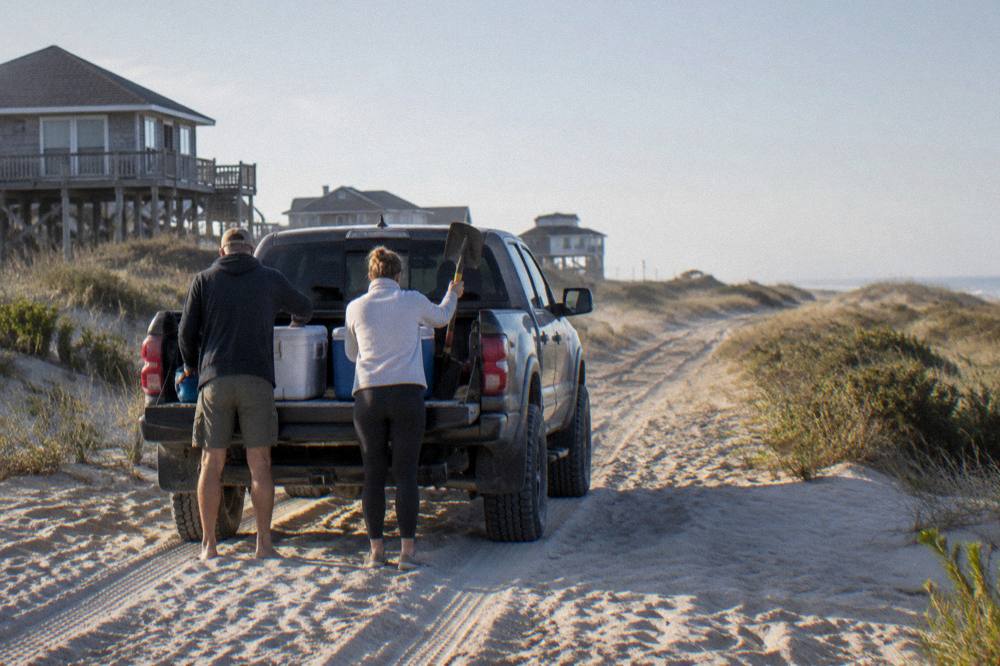
One closing note on the horses themselves, because access rules and horse rules meet on the same sand. However you enter the 4x4 area, the ordinance applies: keep your distance, never feed or lure, and report an injured horse to the Corolla Wild Horse Fund at 252-453-8002 or, after hours, county dispatch. The beach road is shared infrastructure, and the herd's continued freedom on it depends on every driver and rider treating it that way. Corolla North Carolina Horse Tours helps you sort out that arrangement, with one bookable 4x4 truck tour from $65 per person.
Common Questions About Carova Beach Access
Do you need a 4x4 to get to Carova Beach?
Yes. Route 12 ends at its terminus in Corolla, traffic is diverted onto the beach, and the U.S. Fish and Wildlife Service states that four-wheel drive is required from that point. The beach is the only road access to Carova, North Swan Beach, and Swan Beach; the alternative is arriving by boat.
Is the beach at Carova a public road?
Yes. The Corolla Wild Horse Fund's history pages describe the beach north of the paved road as a public road, open to the public, and the only access for residents and guests of the communities in the 4x4 area. Ordinary road rules and the county's wild horse ordinance both apply.
Do you need a permit to drive on Carova Beach?
No county or state permit or fee for driving this beach appears on any official visitor page, so plan to arrive without one. County guidance asks drivers to use 4WD at the ramp and maintain a slow, steady speed. Confirm current requirements with Currituck County before your trip.
What hours do tour vehicles operate on the beach?
Currituck County prohibits commercial tour operation west of the dune line in the 4x4 beach area before 8 a.m. and after 8 p.m. Amplified sound is banned there at all times, and tour vehicles must display a valid North Carolina tag plus county-issued yearly identification.
Can you see the wild horses without driving the beach yourself?
Yes. The 2-hour open-air 4WD truck tour, rated 4.8 across 2,871 reviews and from $65 per person, takes guests into the 4x4 area with a licensed driver and guide, meeting at 1148 Ocean Trail in Corolla before the sand begins. The free and self-guided options are covered in the see Corolla wild horses without a tour guide.
How far is Carova Beach from where the pavement ends?
The paved road ends in Corolla, and the sand corridor runs roughly eleven miles north to the Virginia state line. Carova itself sits within that stretch, alongside North Swan Beach and Swan Beach, with no services beyond what the private communities provide.