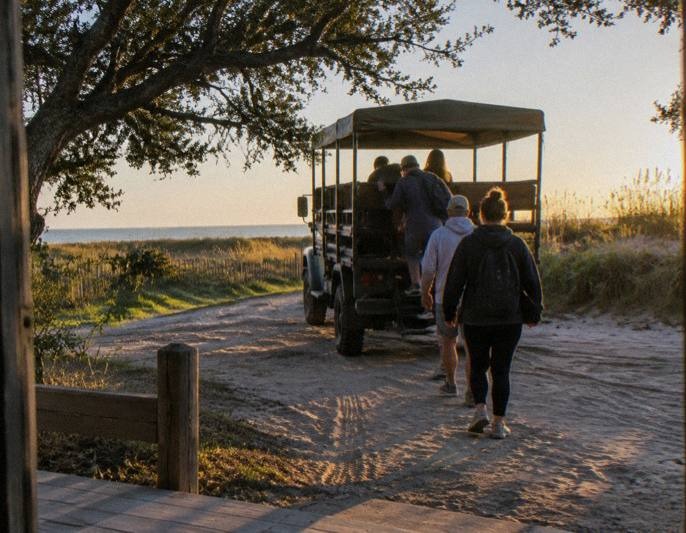
Best Time Of Day To See Corolla Wild Horses
The time of day you choose for a Corolla wild horse tour changes what the beach looks like, how the herd behaves and how comfortable the ride is. Here is how morning, midday and late afternoon compare, and what the county's 8 a.m. to 8 p.m. tour window means for your booking.
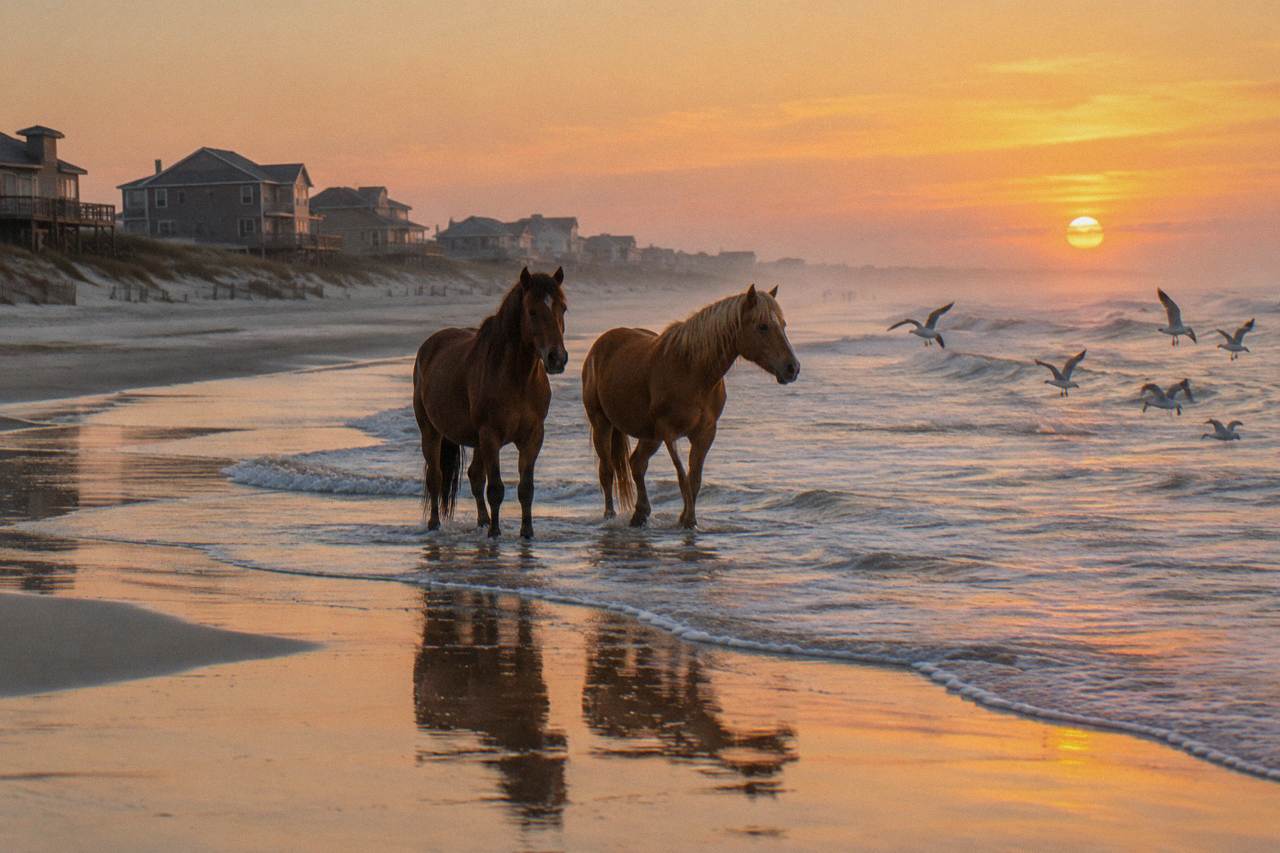
Short answer
The best time of day to see wild horses in Corolla is early morning or late afternoon, when heat and biting insects are lower and the herd moves more freely between the maritime forest and the beach. County rules allow guided tours on the beach only between 8 a.m. and 8 p.m., so the earliest and latest licensed slots sit closest to those hours.
Picking a departure time is the single biggest decision inside a Corolla wild horse tour booking, bigger even than which operator you ride with. The horses roam over 7,544 acres of mixed habitat north of where the paved road ends, and where they are at any moment depends on heat, insects, wind and the tide, not on a schedule anyone can promise. What a rider can control is when they are out there, and the county's rules shape that window tightly: guided tour vehicles may not operate west of the dune line before 8 a.m. or after 8 p.m.
That makes the real question narrower than most visitors expect. It is not "when are the horses out," because they are out around the clock on their own terms. It is "which two-hour block inside the legal tour day gives me the best combination of horse movement, light, and comfort," and the answer leans toward the shoulders of the day. The 2-hour open-air 4WD truck tour rated 4.8 across 2,871 reviews, from $65 per person, runs inside exactly that window, so slot choice is where the planning happens. For the fuller picture on value, the guide to whether Corolla horse tours are worth it covers the other half of the decision.
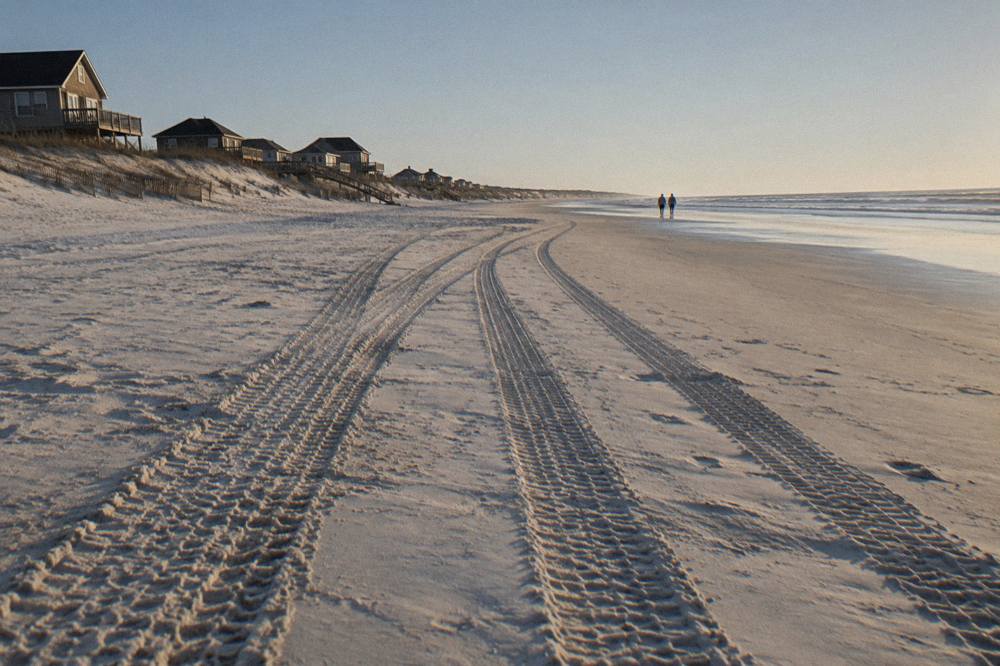
What Time Of Day Is Best To See Wild Horses In Corolla?
The best times of day are the first licensed departures after 8 a.m. and the last slots of the afternoon, because the herd moves most when heat and biting flies are weakest. Currituck County allows tour vehicles on the beach only between 8 a.m. and 8 p.m., so the "shoulders" of that window are the closest a booked rider can get to dawn and dusk, which are when wild horses naturally travel to water and graze.
Wild horses, like most large grazers, alternate between feeding and resting through the day, and the forces that push them out of the scrub are strongest when the day is at its harshest. Reporting on the 2026 season described the pattern plainly: biting flies and shifting winds in spring pushed horses out of secluded areas onto the beach, and by midsummer heat stress was doing the same work the insects had done earlier, forcing animals out of cover and into the open where the breeze and the water's edge cool them down. That cuts both ways for a visitor. A hot midday tour can actually produce beach sightings, because the horses come to the surf to stand in it, but it is also the least comfortable time to sit in an open-air truck on sand. If you'd rather plan around the herd's habits than gamble on the weather, our guide to the hours when Corolla's wild horses are most visible explains how heat, insects and tour schedules shape the odds.
The morning case is about movement and light. Early departures catch the herd traveling between water sources and shade, and the low sun makes the backdrops, dune lines, ocean, the shadowed maritime forest edges, worth photographing. The afternoon case is about repetition of that pattern in reverse: as heat breaks, horses drift back toward feeding areas, and the last tours of the day ride out under softer light and thinner crowds. Between the two there is no wrong answer, only trade-offs, and the table below puts them side by side.
How Do Heat And Insects Change Horse Behavior Through The Day?
Heat and biting insects are the two forces that reliably move the Corolla herd, and both peak in the middle of the day during the warm months. When either one builds, horses leave the shaded scrub and secluded swales for the open beach and the water's edge, which concentrates sightings along the sand even as it makes the ride itself hotter for passengers.
The mechanism is simple. The horses' range is a mix of private land and public acres, roughly 700 houses, marsh, maritime forest and open beach, and the animals rotate through it seeking shade, fresh water, breeze and relief from flies. Spring on the Outer Banks brings biting flies and shifting winds; summer brings heat. In both cases the observable result reported through the 2026 season was the same: horses relocating, seasonally and predictably, onto the beach where tour trucks drive. A rider who books a midday slot in July is betting on that pattern, and it is a reasonable bet, but it comes with an open-air truck in full sun, so sunscreen, water and a hat belong on the truck with you. The packing guide on what to wear and bring on a Corolla 4x4 horse tour covers that side of the decision.
| Condition | When it peaks | What it does to the herd | What it means for a tour slot |
|---|---|---|---|
| Biting flies and wind | Spring, midday warmth | Pushes horses out of secluded cover onto the beach | Midday spring tours can find horses in the open |
| Heat stress | Midsummer, midday | Drives horses to the surf line to stand in moving water | Beach sightings likely, ride comfort lowest |
| Cool mornings | Early departures after 8 a.m. | Herd travels between water and shade, active movement | Best light, comfortable ride, thinner crowds |
| Late afternoon break | Final slots before 8 p.m. | Drift back to feeding areas as heat eases | Soft light, relaxed pace, another movement window |
One honest caveat belongs here. No operator can promise a sighting, and none should, because the herd moves on its own calendar over thousands of acres. What the time-of-day logic buys you is probability and comfort, not a guarantee. The Corolla Wild Horse Fund, the nonprofit that manages the herd, describes horse locations as variable and asks visitors to let the animals set the distance.
When Are Guided Tours Allowed On The Beach In Corolla?
Currituck County prohibits tour vehicles from operating west of the dune line in the four-wheel-drive area before 8 a.m. and after 8 p.m., which sets a hard frame around every licensed departure slot. The same county rules bar amplified sound on that stretch of beach at all times and require tour vehicles to display a valid North Carolina license tag and county-issued yearly identification.
Those rules come from the county's horse tour page, and they exist to keep the beach workable for residents, visitors and the herd at once. The beach north of the paved end of NC-12 is a public road, the only vehicle access for people staying in Carova, North Swan Beach and Swan Beach, so licensed tour trucks share it with homeowner traffic. The 8 a.m. opening and 8 p.m. closing compress every commercial ride into a twelve-hour day, and in practice the most requested slots sit at the two ends of it, the first departures of the morning and the last ones of the evening, exactly the shoulders where horse movement and pleasant temperatures overlap.
For a booker, the practical effect is simple: the "sunrise ride" and "sunset ride" that a visitor might imagine do not exist as licensed commercial products on this beach. The closest legal equivalents are an 8-something a.m. departure, which catches morning light within an hour of sunrise for much of the season, and a late slot that ends near 8 p.m., which in summer finishes close to sunset. A two-hour tour booked for a 6 p.m. departure, when the operator's schedule offers one, spends its final stretch in the golden hour. The county states these tour rules on its horse tours page, and the Fund's own frequently asked questions cover the visitor-side distance rules that apply on the same sand.
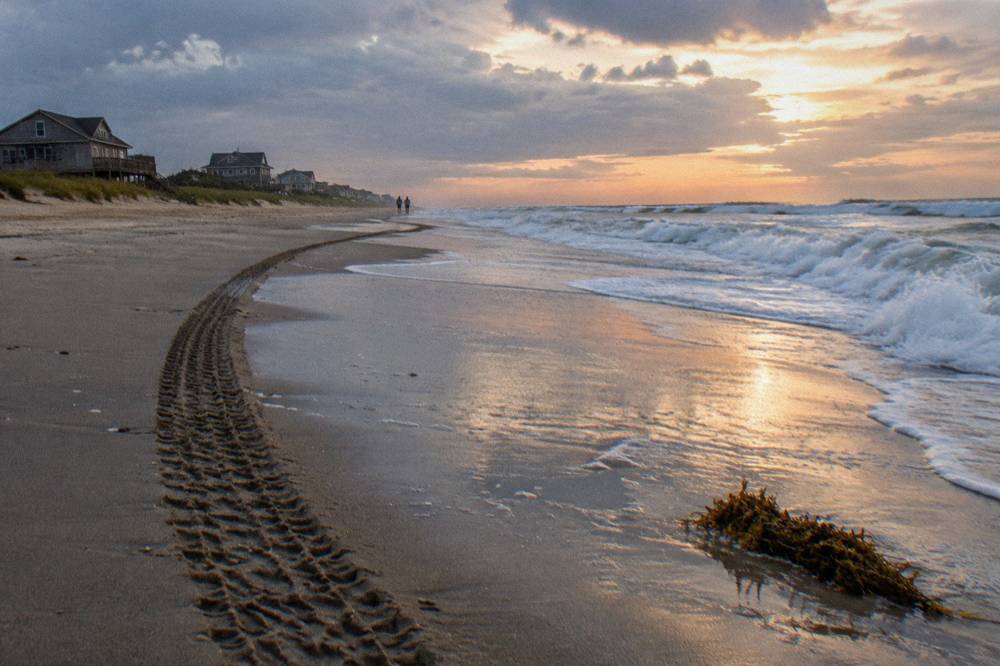
What Does A Two-Hour Tour Slot Mean For Sightings?
A two-hour slot means the truck covers the length of the accessible beach between the dune line and the surf while the herd is somewhere inside the same stretch, which is why operators can describe sightings as likely without promising them. The featured tour runs about two hours in an open-air 4-wheel drive truck carrying up to 12 travelers, from a meeting point at 1148 Ocean Trail in Corolla.
Two hours is the standard length across the Corolla market, and it is not arbitrary. The beach drive north through the four-wheel-drive area to the areas the herd frequents and back is a genuine distance; one long-standing operator's own page describes its two-hour route as covering about 25 miles of off-road cruising. That travel time is the product: a licensed driver who reads sand conditions, a guide who knows the herd's seasonal haunts, and enough time to work the length of the beach until the guide finds horses rather than hoping a horse finds you. The featured 2-hour 4WD truck tour, run with the supplier Benders Beach Services and rated 4.8 across 2,871 reviews, uses exactly this model, and the tour page shows the live departure times and the from $65 per person starting price.
The slot length also interacts with time of day in a way worth planning around. A morning departure at the start of the legal window rides out when the herd is mid-movement and spends its second hour in building light. A late-afternoon departure reverses that: the first hour is warm and bright, the second hour cools into the day's best photography conditions. Midday slots run hot end to end in summer but, as the heat pattern above explains, they are also riding through the hours when horses stand in the surf, which many riders consider the most memorable sight of all. If comfort on a rough ride is a concern, the write-up on whether the Corolla horse tour is bumpy is the companion read.
| Departure slot | Conditions on the truck | Herd behavior window | Trade-off |
|---|---|---|---|
| First morning departures after 8 a.m. | Coolest air, low sun | Active travel between water and shade | Lighter crowds, earliest legal start |
| Late morning | Warming, brighter | Settling toward shade or surf | Good balance of comfort and sightings |
| Midday | Hottest, full sun | Horses often at the water's edge in summer | Best surf sightings, least comfort |
| Late afternoon | Heat easing, softening light | Drift back to feeding areas | Best photography light, busier beach |
| Final slots ending near 8 p.m. | Cooling, golden hour | Evening movement | Latest legal finish, timing depends on season |
Does The Tide Change When You Should Book?
The tide changes the width of drivable sand and where horses stand, not the county's tour hours, so it matters as a comfort and viewing factor rather than a scheduling rule. Tides do not restrict tour schedules here, county and Fund pages set no tide-based rules, and trucks run on every legal hour of the day regardless of the tide.
At high tide the wet-sand corridor narrows and trucks run closer to the water and the dune line, which can place riders nearer to horses that are standing in the shallows. At low tide the beach widens, the driving is easier and the horses' surf-line gatherings sit farther from the vehicle track. None of this is controllable from a booking screen, since tide cycles shift later each day and slot times are fixed by the operator's schedule, but it explains why two identical 10 a.m. tours on consecutive days can feel like different beaches. Riders who care can check a tide chart for the Corolla beach before choosing between a morning and an afternoon departure on the same date, and simply pick the one that pairs their preferred light with their preferred sand width.
What the tide does not do is create a "best" time that outranks heat and horse behavior. The herd's response to temperature and insects is the dominant pattern reported season after season; the tide just dresses the stage differently. Treat it as a tiebreaker between two slots you already like.
| Tide state | Beach and driving conditions | Viewing effect | Booking effect |
|---|---|---|---|
| High tide | Narrower wet-sand corridor, trucks closer to water and dune line | Horses in the shallows sit nearer the vehicle track | Slightly slower, closer-passing ride |
| Falling tide | Sand widening as water retreats | Surf-line gatherings gradually pull away from the track | Easier driving through the slot |
| Low tide | Widest beach, easiest driving | Horses spread across more open sand | None; tours run on every legal hour |
| Rising tide | Corridor narrowing through the slot | Viewing angles tighten near the end of a ride | A tiebreaker only, never a scheduling rule |
Are Morning Or Afternoon Tours Better With Kids?
Morning departures fit younger children better in warm months, because the ride happens before peak heat and before the afternoon attention slump, and the listing for the featured tour sets a minimum age of five years and 40 pounds. That floor matters more than the clock: a child who cannot ride the truck cannot ride it at any hour.
The practical arithmetic for families is about the two hours in an open truck. A mid-morning start in June keeps the whole ride in genuinely comfortable air rather than peak heat, shortens the sunscreen burden, and lands back at the parking lot by lunch and nap time. Late-afternoon slots can work for school-age kids who sleep in, and they end near the day's coolest, most photographable hour, but they also run against dinner and bedtime for the youngest riders. The family-focused write-up on Corolla horse tours with kids works through packing and expectations in more detail.
The listing's own terms frame the rest. The truck is open-air, it is not wheelchair accessible, the ride is described as needing moderate physical fitness, and it is not recommended for travelers with back problems. Food and drinks are not included, so families booking a morning slot usually bring water and snacks for the children even though nothing is sold on board. None of those constraints change with the hour of departure; they simply bite harder at midday, which is one more quiet argument for the shoulders of the day.
How Does The Season Change The Best Hour Of The Day?
The best hour shifts with the season: in spring and fall, midday slots are comfortable and productive because heat is mild, while in peak summer the advantage swings hard to the first and last legal departures. Winter brings a different market entirely, with some operators switching to enclosed vehicles and shorter schedules, so the hour question is really a month question first.
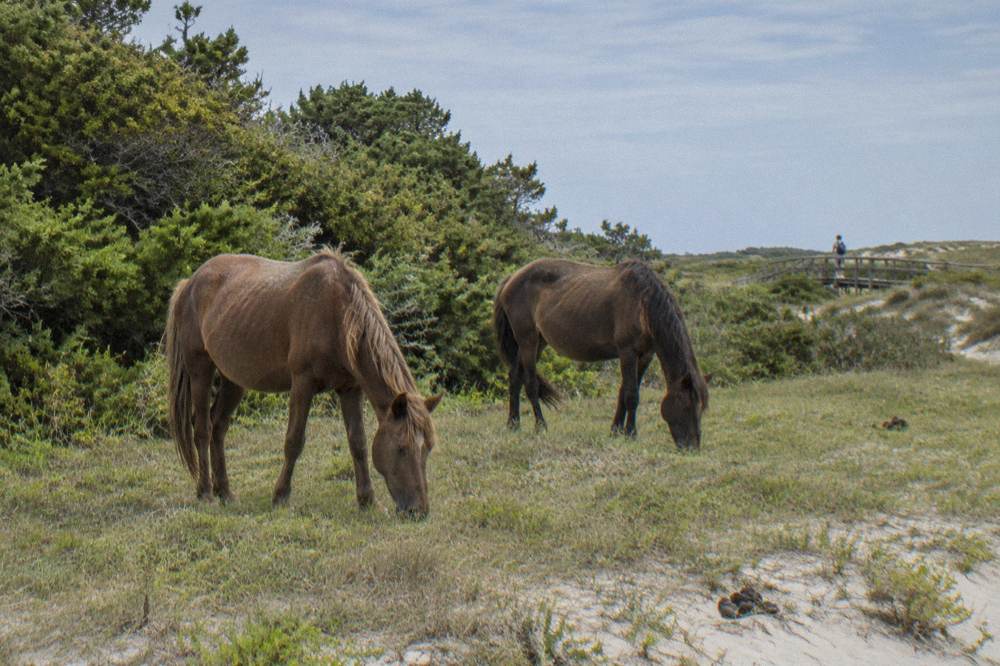
Spring is the season of movement. Biting flies and shifting winds push the herd out of secluded areas, and reports through the 2026 season described crowds gathering near the southern fence in April as horses appeared on the open beach. A midday spring slot rides in genuinely pleasant air. Summer inverts the logic: the same heat that pulls horses to the surf makes a midday open-truck ride punishing, so early and late slots carry double value, comfort plus the golden light. Fall eases everything; the herd's behavior relaxes with the temperature, and locals note that the horses keep their own calendar after the Labor Day crowds leave, spreading back across their range rather than hugging the busiest sand.
The seasonal layer also changes what the market offers. The direct operators' own pages show the pattern: one long-standing Corolla operator runs open-air trucks from April through November and switches to an enclosed SUV tour from January through March, while another lists in-season rates from May 1 to October 1 and reports operating seven days a week with 8 a.m. to 8 p.m. hours. The featured tour runs as an open-air truck with a 12-traveler cap, and the booking page shows which dates and times are live. For the month-by-month picture, the companion guide on the best time of year to see wild horses in the Outer Banks extends this same logic across the calendar.
| Season | Best hour of the tour day | Why | Market notes from operators' own pages |
|---|---|---|---|
| Spring | Midday and morning both work | Flies and wind push horses onto the open beach | One operator opens its open-air truck season in April |
| Peak summer | First departures after 8 a.m., last slots before 8 p.m. | Heat pulls horses to the surf but makes midday rides punishing | In-season rates run May 1 to October 1 at one operator |
| Fall | Any legal hour, late afternoon for light | Heat eases, herd spreads back across its range | Open-air truck season runs through November at one operator |
| Winter | Midday, daylight dependent | Mild crowds, colder air, enclosed vehicles in the market | One operator switches to an enclosed SUV January through March |

What About Watching At Dawn Without A Tour?
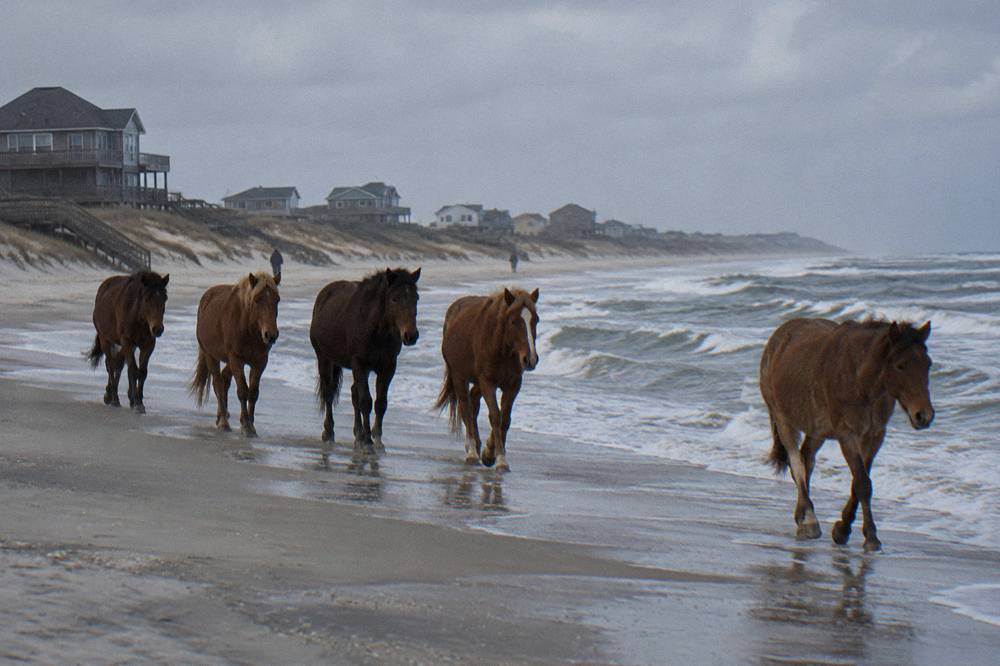
The hours outside the tour window belong to self-directed viewing, and the Fund's distance rules apply around the clock, so anyone walking the beach before 8 a.m. must still stay at least 50 feet from any horse. Self-driving the beach requires four-wheel drive, and county guidance tells drivers to keep a slow, steady speed and to stay off the sand entirely without 4WD.
Some visitors reason that since horses move at dawn and dusk, and licensed trucks cannot run then, the smart play is to walk or self-drive at those hours. It is a real option and the beach is public road north of the paved terminus, but it trades a guide's knowledge of the herd's current haunts for solitude, and it puts the full legal burden on you. The county's wild horse ordinance makes feeding the horses or coming within 50 feet of them punishable by law, regardless of a person's experience with horses, and if horses approach you, keeping the distance is your responsibility. The Fund asks that dangerous behavior be reported to Currituck County dispatch. The comparison piece on driving the Corolla 4x4 beach yourself versus a guided tour and the guide to seeing the Corolla wild horses without a tour lay out both paths honestly. Whatever approach you choose, the herd's backstory of shipwrecks, near extinction, and hard-fought protection adds real weight to those rules, and the history of the Corolla wild horses and their Spanish colonial roots tells it well.
For most visitors the guided shoulder slots are the better use of a vacation day: they capture most of the dawn-and-dusk advantage inside a legal, guided, insured ride, and they put a trained spotter behind the wheel. The free-dawn walk remains a lovely backup for the morning you do not have booked.
Common Questions About The Best Time Of Day For Corolla Wild Horses
What time of day is best to see wild horses in Corolla?
Early morning departures just after the 8 a.m. opening and late-afternoon slots ending near 8 p.m. offer the best mix of horse movement, comfortable temperatures and good light. In peak summer, midday slots can also produce strong sightings because heat drives the horses to stand in the surf, but the open-air ride is hottest then.
Can tours run at sunrise or sunset in Corolla?
No. Currituck County prohibits tour vehicles from operating west of the dune line before 8 a.m. or after 8 p.m., so the earliest and latest licensed slots are the closest options to true sunrise and sunset riding.
Do wild horses come out more at a certain hour?
The horses are active on their own schedule, but heat and biting insects reliably push them onto the open beach, which concentrates visible activity around midday in summer and during the cooler movement windows at the start and end of the day.
Does the tide affect which tour time to pick?
The tide changes the width of drivable sand and how close the truck passes to horses standing in the shallows, but it does not change tour hours. Treat the tide chart as a tiebreaker between two slots you already like.
Is a morning or afternoon tour better with children?
Morning is usually the better family slot in warm months, with cooler air and an earlier finish. The featured tour's listing sets a minimum of five years old and 40 pounds, which applies at every departure time.