What Is Corolla NC Known For?
Corolla, North Carolina is known for its wild horses, the Currituck Beach Lighthouse and the 4WD-only beaches north of the paved road. Here is what the town is famous for.
What Brings People To Corolla In The First Place?
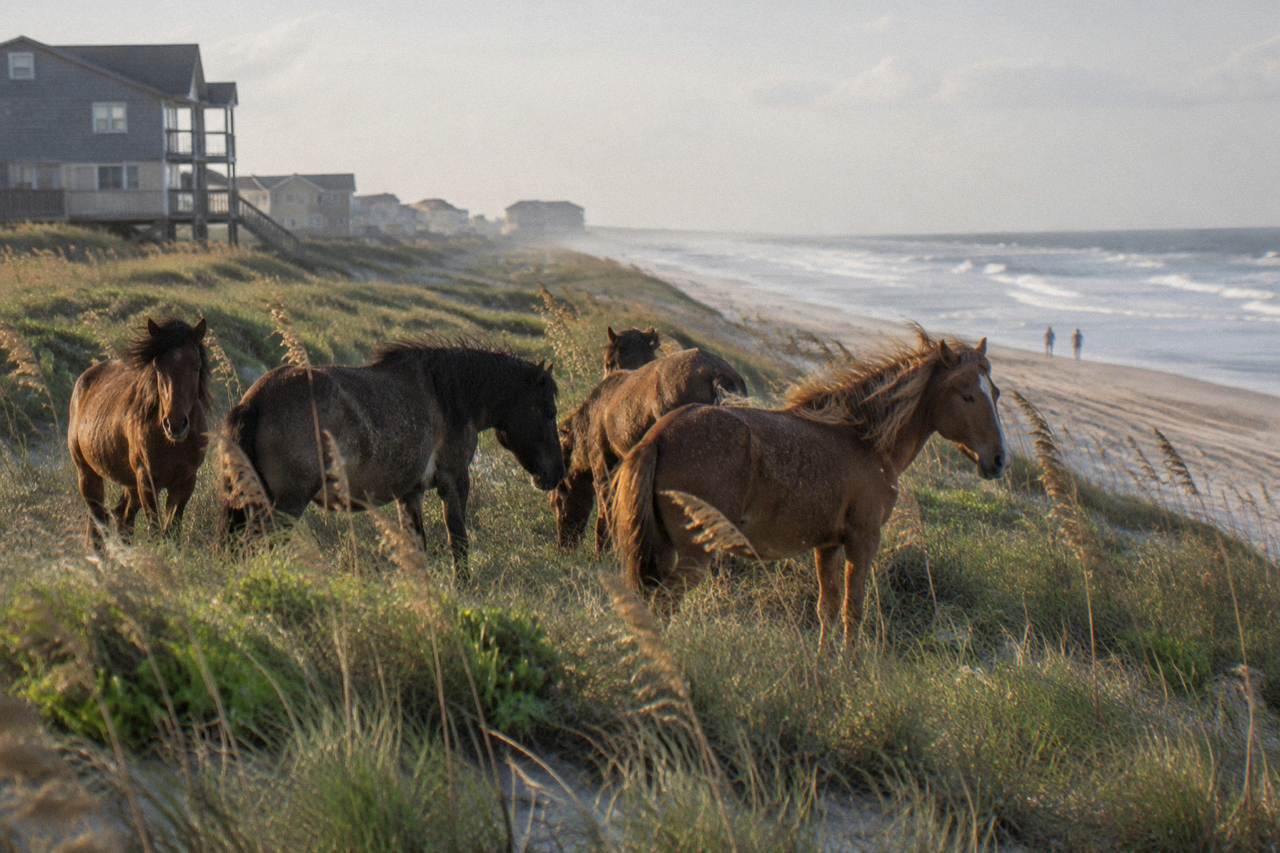
Corolla, North Carolina is known for its wild horses, the Currituck Beach Lighthouse and the four-wheel-drive-only beaches north of where the paved road ends. The town sits at the top of the Outer Banks barrier islands, and its fame rests on a herd of Colonial Spanish Mustangs that roams the sand north of NC-12, reachable only by 4WD. Before you drive onto the sand, the guide to Corolla's beaches and the wild horses explains where public access starts and how to keep a safe distance from the herd.
That short answer hides a longer story. Corolla was a quiet, sparsely built village until the arrival of the paved road from Duck, after which development followed. The wild horses that had wandered freely across the whole island were moved north of the paved road for their own protection, and today they live on the "4x4 area", the stretch of beach and maritime forest between the end of NC-12 and the Virginia state line. The Corolla Wild Horse Fund, the nonprofit that manages the herd, describes the range as 7,544 acres of diverse habitat that includes hundreds of houses and the vehicles that come with them. If you're wondering where to actually spot the herd on that land, our guide to the best places to see the wild horses in Corolla explains how the seasons change the answer.
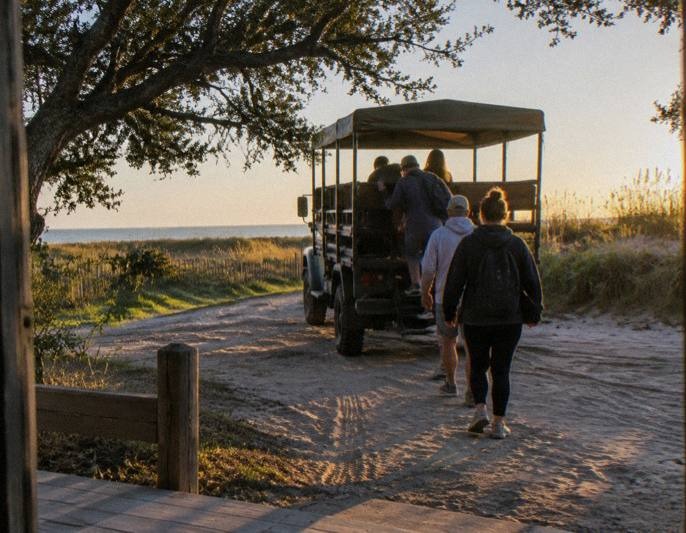
Visitors who want the classic Corolla experience usually book a guided trip into that area, and the 2-hour open-air 4WD truck tour is the town's signature outing, rated 4.8 across 2,871 reviews and priced from $65 per person on the booking page. A confirmed seat on a licensed truck is the simplest way into the 4WD beaches for travelers who arrive in a regular rental car.
Beyond the horses, Corolla is known as a family-friendly resort town with a genuine historical anchor. The Currituck Beach Lighthouse, the restored Whalehead club, and the village's shops and restaurants give the town more depth than the average beach strip. The pages below unpack each piece of that reputation, starting with the one that puts Corolla on the map.
The Wild Horses Of Corolla's Northern Beaches
The wild horses are Corolla's single biggest claim to fame. Descendants of Colonial Spanish Mustangs, they roam the northern beaches and maritime forest, and the North Carolina General Assembly named the Colonial Spanish Mustang the state horse. Seeing them is the reason many families choose Corolla over other Outer Banks towns. Beyond the horses, our guide to everything Corolla is famous for covers the lighthouse, the off-road beaches, and how a wild horse tour fits into your trip.
The Fund's history is tied directly to the road. Between 1985, when the highway between Duck and Corolla was paved, and 1989, eleven horses were hit and killed on Highway 12, according to the Fund's own history page. The community response became the Corolla Wild Horse Fund, organized in 1989 and incorporated as a nonprofit in 2001, and the horses that frequented the village were relocated north of the paved road. That decision shaped everything visitors encounter today: a herd living on a roadless stretch of coast, in sight of vacation rental houses but managed as wild animals.
Management is hands-off in style but tightly run in practice. The Fund's herd management page explains that the horses are identified by color, markings and home territory rather than branded or microchipped, that as many as six aerial counts are conducted by helicopter, and that the Fund reports to the County's Wild Horse Advisory Board. The herd's size is a moving number, tracked by survey rather than posted as a fixed figure, and the Fund is the source to trust for it.
The rules around the horses are strict, and they are a real part of what Corolla is known for. Currituck County's wild horse ordinance makes it illegal to come within 50 feet of a wild horse, and feeding them or getting close is punishable by law, as the Fund states plainly on its ordinance page. On the federal side, the Currituck National Wildlife Refuge's visitor guidance says it is unlawful to harm, approach or feed any wild horse on the refuge. Tour trucks follow the same 50-foot rule, which is one reason a guided tour works: licensed operators know how to position a vehicle so riders see the horses well without disturbing them.
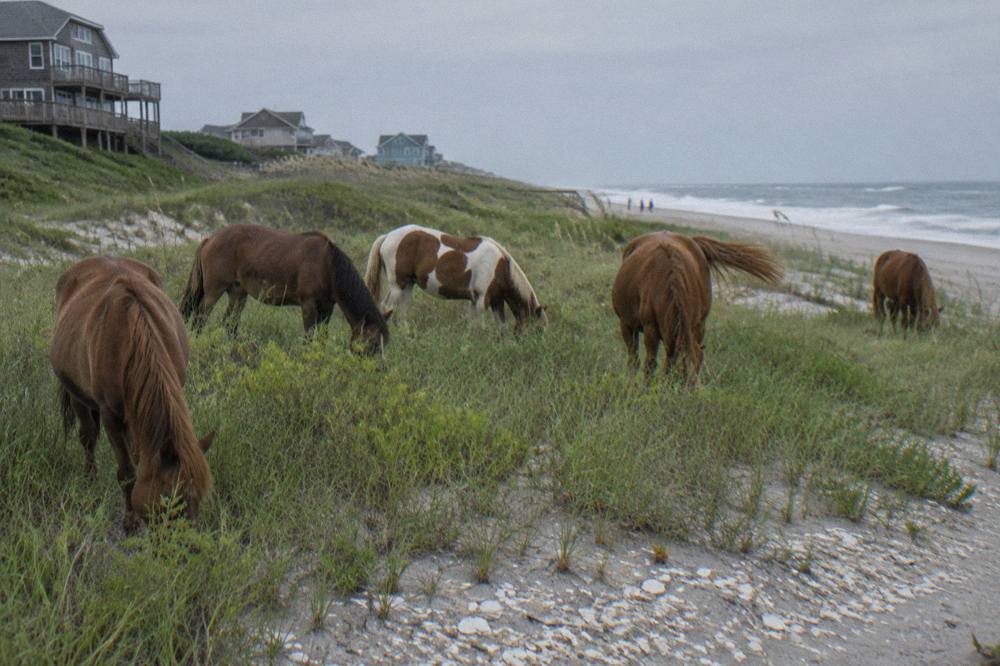
For planning purposes, the horses move with the seasons, and that pattern is predictable. Biting flies and heat push them out of secluded cover and onto the open beach in the warmer months, which is when tour trucks and self-driving visitors tend to find them in view. Nothing is guaranteed with wild animals, but the seasonal logic is well documented, and the guides who drive the beach daily read it in real time.
The guide to the 50-foot rule and horse etiquette covers the do's and don'ts in full, including what to do if horses approach you on the beach.
The Currituck Beach Lighthouse And Corolla Village
Corolla is also known for the Currituck Beach Lighthouse, an unpainted red-brick tower that still works as an active aid to navigation. It anchors the historic village at the foot of the paved road, alongside the restored Whalehead club, and it gives the town a landmark that predates every rental house on the island.
The lighthouse and Whalehead sit within walking distance of each other, and together they form the cultural core most visitors see on the way to or from the horse tour. The pattern that works for most families is simple: the guided 4WD truck tour runs about two hours, meeting at a lot on Ocean Trail in Corolla village, which leaves the rest of the day for climbing the lighthouse, touring Whalehead and browsing the village shops. The lighthouse and Whalehead pairing guide lays out that half-day and full-day structure in detail.
The village end of Corolla is also where the Fund's museum and gift shop lives, on Corolla Village Road, open seasonally Tuesday through Saturday. It is a small stop, but for families it answers the questions the beach raises: where the horses came from, how the Fund manages them, and what the rescue farm on the mainland does. The museum and Mustang Mornings guide explains what to expect and how the farm visits work.
| Corolla landmark | What it is | Where it sits |
|---|---|---|
| Currituck Beach Lighthouse | Unpainted brick lighthouse, active navigation aid | Corolla village, end of the paved road |
| Whalehead | Restored historic hunt club, open for tours | Beside the lighthouse, on Currituck Sound |
| Wild horse museum and gift shop | Fund-run museum on the herd's history | Corolla Village Road, seasonal hours |
| The 4WD beaches | Roadless sand north of NC-12, home to the herd | Access requires four-wheel drive |
That last row is the one that surprises first-time visitors, and it deserves its own section.
The 4WD Beaches North Of The Paved Road
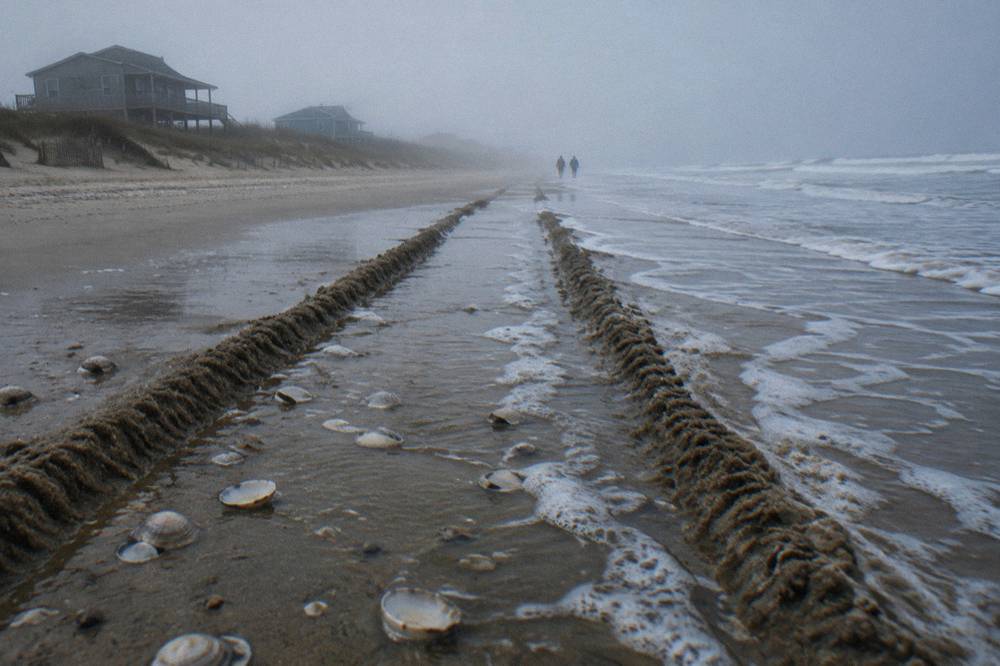
Corolla is known for something few beach towns can claim: its most famous attraction sits past the end of the paved road. North of where NC-12 terminates, the beach itself becomes the public road, and four-wheel drive is required. The neighborhoods there, Carova, North Swan Beach and Swan Beach, are reachable only by driving on sand or by boat.
The US Fish and Wildlife Service states it directly for the refuge tracts: follow Route 12 north to its terminus in Corolla, where traffic is diverted onto the beach, and four-wheel drive is required, with vehicle traffic restricted to the beachfront. The Fund's history page confirms the beach north of the paved road is considered public road, open to the public, and that it is the only access for residents and guests staying in the Carova area.
This is the practical fork in every Corolla trip. Visitors with a 4WD vehicle, and the willingness to read the sand, can drive the beach themselves and look for horses from a lawful distance. Everyone else has two options: walk in from the northern beaches near the village, or ride with a licensed operator. The driving the beach versus a guided tour guide compares the two honestly, and the 4x4 access rules page covers what county guidance asks of drivers: use 4WD, keep a slow steady speed, and do not attempt the beach without it.
The guided route has real advantages for the destination traveler. The 2-hour Outer Banks Wild Horse Tour by 4WD Truck carries up to 12 travelers in an open-air truck from a meeting point on Ocean Trail, with a guide whose job is to find the herd and interpret what riders are seeing. The listing is rated 4.8 across 2,871 reviews, from $65 per person, with the booking page showing the live price and current departure times.
County rules also shape how those tours run, and they are part of the town's character. The county's horse tour rules page requires tour vehicles to display a valid North Carolina tag and County-issued yearly identification, prohibits tour operation west of the dune line before 8 a.m. or after 8 p.m., bars amplified sound in that zone at all times, and directs tour vehicles to stay at least 50 feet from the wild horses. A licensed truck is therefore not just transportation: it is a regulated viewing platform operating under rules written to protect the herd.
The Currituck National Wildlife Refuge
Corolla is known as the gateway to the Currituck National Wildlife Refuge, thousands of acres of maritime forest and brackish marsh spread across six units between the town and the Virginia line. The refuge has no developed facilities, no trails, no restrooms, and it is open daily from sunrise to sunset, reached by boat or four-wheel drive.
The refuge's visitor page describes it plainly: no roads, no visitor contact station, no waste disposal, and a short list of prohibitions that includes baiting or feeding wildlife, explicitly including the Corolla wild horses, all commercial activities and pets off-leash. The public may park on the beach and walk in. For most visitors the refuge is scenery rather than a destination: it is the green backdrop to the northern beach drive, and its tracts are part of why the 4x4 area feels genuinely wild rather than like a suburb on sand.
The refuge's own framing of the horses is worth knowing. The federal page describes them as feral mammals that are not a natural component of the barrier island, occasionally seen, and to be viewed only from a distance. The Fund and the County, who actually manage the herd, take a different view of its history and value, and the state has honored the Colonial Spanish Mustang as the Official Horse of North Carolina. A visitor does not need to referee that debate: the practical takeaway is that every authority with jurisdiction agrees on one thing, keep your distance and never feed them.
What Else Corolla NC Is Known For
Corolla is known as an upscale, family-oriented beach town with big rental houses, quiet offseason shoulder seasons and a compact village of shops and restaurants. It has no boardwalk and no nightlife strip, and its reputation rests on natural attractions rather than built ones, which is exactly why families and wildlife watchers choose it over livelier Outer Banks towns.
The town's texture is worth a paragraph because it shapes every trip. Corolla sits at the end of the road, literally: drive north through Duck and the village, and the pavement stops. That geography caps development and keeps the northern beaches distinct from the resort strips farther south. Families book large houses on the wide southern beaches, spend mornings on the sand, and often build one signature outing around the herd, which is where the horse tour fits into a typical week. The three-day Outer Banks itinerary with a horse tour shows how those pieces stack up.
| Corolla draw | Best for | Typical time needed |
|---|---|---|
| Wild horse tour by 4WD truck | First-time visitors, families | About 2 hours |
| Currituck Beach Lighthouse | Views, history, all ages | 1 to 2 hours |
| Whalehead and village shops | A slower half day | 2 to 3 hours |
| 4WD beach drive or walk-in | Confident drivers, repeat visitors | Half day, conditions permitting |
| Refuge and northern beaches | Wildlife watchers | Varies, no facilities |
Comparison shoppers often weigh Corolla against Duck, its neighbor to the south, and the honest answer is that Duck wins on walkability and dining while Corolla wins on wildness and the horses. The Corolla versus Duck comparison breaks that trade-off down for trip planners.
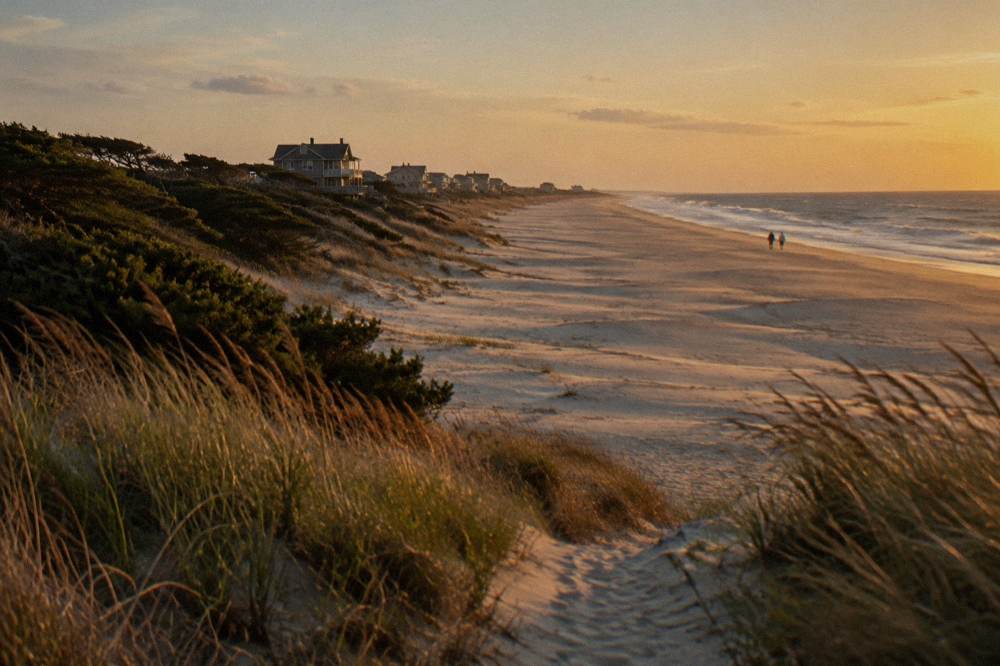
Seasonality matters more here than in most beach towns. The horses are present year-round, but the guided tours, the village shops and the lighthouse all run seasonal calendars, and the beach itself changes character with the weather. The best time of year guide and the time of day guide cover the timing questions in depth. Whatever the season, plan your visit around the tour calendar: open-air truck trips to see the wild horses run April through November, with enclosed SUV options in the winter months, and most outings last about two hours.
If the horses are the reason you are considering Corolla, the practical first step is a seat on the guided 4WD truck tour described across these pages.
Common Questions About Corolla NC
What is Corolla NC known for?
Corolla NC is known for its wild horses, the Currituck Beach Lighthouse and the four-wheel-drive-only beaches north of the paved road. The town sits at the northern end of the Outer Banks, and its herd of Colonial Spanish Mustangs is the state horse of North Carolina.
Are the Corolla wild horses really wild?
They are managed as wild animals. The Corolla Wild Horse Fund identifies them by color and markings rather than branding them, counts them by aerial survey, and reports to the County's Wild Horse Advisory Board. County ordinance makes it illegal to come within 50 feet of them, and feeding them is punishable by law.
Can you see the horses without a tour?
Yes, sometimes. The beach north of the paved road is public, and visitors walk in or drive a 4WD vehicle to look for the herd from a lawful distance. Sightings are never guaranteed with wild animals, and licensed tour trucks, which follow county rules including the 50-foot distance, are the reliable option for most visitors.
Do you need four-wheel drive in Corolla?
Only if you are driving past the end of NC-12. The village, the lighthouse and the southern beaches are all on paved roads. The beach north of the paved road is the public road into the Carova area, and four-wheel drive is required; county guidance says not to attempt it without 4WD.
Is Corolla good for families?
Corolla is one of the Outer Banks' most family-oriented towns, with large rental houses, wide beaches and a compact village. There is no boardwalk or nightlife strip. The typical family trip pairs beach days with the horse tour, the lighthouse and Whalehead.
When is the best time to visit Corolla?
Warm months bring the tour season, village hours and the seasonal movement of the herd onto the open beach, though crowds peak in summer. Spring and fall offer quieter beaches with the horses still present. Tours run on seasonal calendars, so check the booking page for current departures.