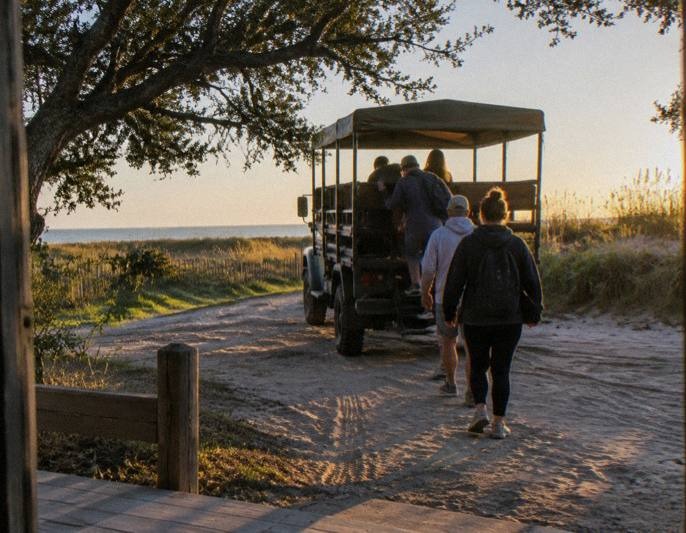
Can You See The Corolla Wild Horses Without A Tour?
Yes, you can see the Corolla wild horses without a tour: here is where to look, what the 50-foot rule allows, and when a guided 4WD trip is the smarter call.
So, Can You See The Wild Horses On Your Own?
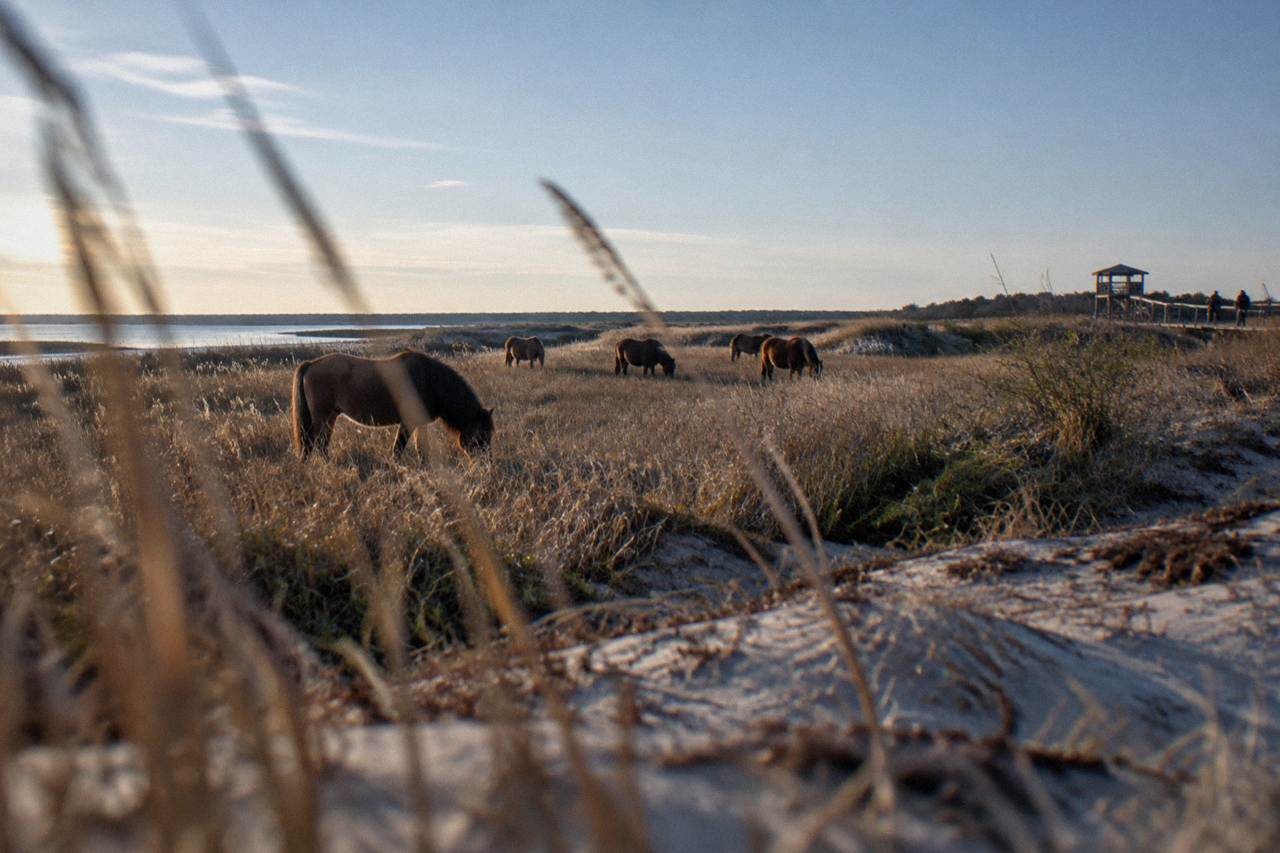
Yes, you can see the Corolla wild horses without a tour, and no law requires a guide to look at them. The practical limits are access and distance: the herd roams roughly 7,544 acres north of where NC-12 turns to sand, you must stay at least 50 feet from any horse at all times, and nobody can promise a sighting on any given day, with or without a guide.
Plenty of visitors do it themselves every year. The beach north of the paved road is a public road by law, open to anyone with a four-wheel-drive vehicle, and the horses also wander close enough to the village edge that walkers and cyclists occasionally get lucky. What a guided trip buys you is not permission but probability: a licensed operator drives the sand daily, knows where the bands have been, and holds a County-issued tour license that keeps the whole outing inside the rules.
That trade-off is worth understanding before you decide, because the two routes cost very different amounts of effort. A self-guided day is close to free. The featured option on Corolla North Carolina Horse Tours, the 2-hour open-air 4WD truck tour from $65 per person, is the one Corolla horse tour sold on a third-party booking platform, with a live calendar and a public review count. Direct operators take bookings on their own sites and by phone.
Where Can You Spot Wild Horses On Your Own In Corolla?
The realistic self-guided spots are the 4WD beach north of the paved road's end, the dune lines and sandy side tracks of the Carova area, and, occasionally, the northern edge of Corolla village itself. The horses move across the whole 7,544-acre range, so no single viewpoint is reliable, and success depends on timing, tides and luck more than on any secret location.
Start with geography. The paved portion of NC-12 ends in Corolla, and north of that terminus the beach itself becomes the road, the only access for people staying in Carova, North Swan Beach and Swan Beach. The Corolla Wild Horse Fund's history pages describe the range as running roughly eleven miles north to the Virginia state line, a mix of private land and public use with hundreds of houses scattered through it. The horses are free to move across all of it, which is why they can be standing in a yard one morning and a mile down the beach by afternoon.
Walking is legal and costs nothing. Visitors who park near the end of the pavement and walk north along the sand do sometimes encounter horses, and this is the cheapest possible version of the experience. The catches are real: it can be a long hot walk with no shade, you are carrying your own water, and a horse you spot from a distance may be far beyond the 50-foot boundary by the time you get near. The Fund's FAQ is blunt that the ordinance applies regardless of anyone's experience with horses, so a self-guided encounter demands discipline, not courage.
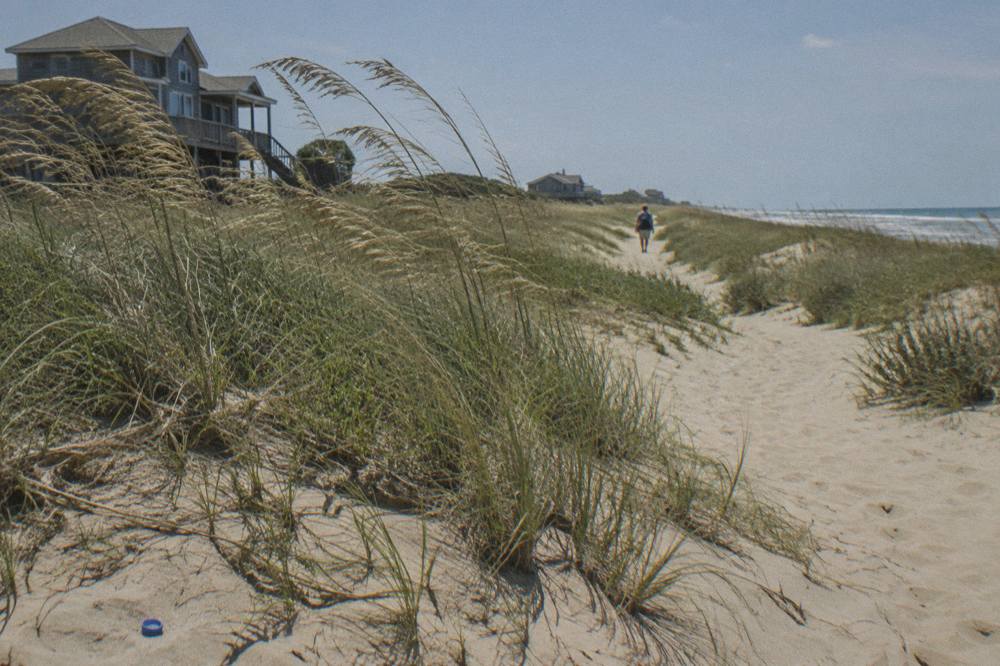
The village edge is the sleeper option. Horses periodically come south of the fence line into the residential streets around Corolla village, and local social media groups light up when they do. Treat this as a bonus, never a plan. If you build a whole day around finding horses on pavement, you will more likely find parking tickets.
What Rules Apply When You Find A Horse Without A Guide?
The core rule is distance: Currituck County's wild horse ordinance makes it unlawful to come within 50 feet of a wild horse, and it is equally unlawful to feed, pet, ride or lure one, with violations punishable by law. The same law applies to every person on the beach, guided or not, and it holds even when a horse approaches you.
The County states it plainly: tour vehicles themselves must stay at least 50 feet from the horses, so a guide gets no closer than you are allowed to. The County's tour-operator page also bans tour operation on the 4WD beach before 8 a.m. and after 8 p.m. west of the dune line, which tells you something useful: the county treats this stretch as a sensitive zone with real enforcement, not a free-for-all. On the refuge land that threads through the north end, the federal rule goes further still; the U.S. Fish and Wildlife Service states it is unlawful to harm, approach, feed or kill any wild horse on the refuge.
The rule that trips people up is the approach scenario. If a horse walks toward you, the Fund's guidance says the responsibility stays yours: back away and keep the 50 feet. Foals are a particular concern. A Fund educational update stressed that foals are extremely impressionable in their first months and must not become accustomed to humans, and that getting too close can stress a band enough that a foal gets separated from its mother. Photograph from a distance, use a zoom, and never position yourself between a mare and her foal.
| Rule | Who it applies to | What it means in practice |
|---|---|---|
| Stay 50 feet away | Everyone, guided or self-guided | Roughly six car lengths; use a zoom lens, not your feet |
| No feeding, petting or riding | Everyone | Human food can be lethal to a wild horse; touching is unlawful |
| Do not lure or entice | Everyone | No treats, no calling, no blocking a horse's path for a photo |
| Report dangerous behavior | Anyone who sees it | Fund at 252-453-8002, or county dispatch at 252-453-3633 after hours |
Injured horses should be reported rather than helped directly. The Fund's published numbers are 252-453-8002 during office hours and Currituck County dispatch at 252-453-3633 after hours. Well-meaning hands-on intervention is one of the fastest ways to turn a good self-guided day into a legal problem, so the correct move is always the phone.
Do You Need A 4x4 To Reach The Horses Yourself?
Strictly, no: you can walk or cycle north from the end of the pavement and legally view horses without any vehicle. Practically, yes: the horses' core range beyond the paved road is reachable only by four-wheel drive or boat, and the U.S. Fish and Wildlife Service states plainly that four-wheel drive is required once traffic diverts onto the beach at the NC-12 terminus.
The beach north of Corolla is soft sand, and county guidance is unambiguous: use 4WD when entering and maintain a slow, steady speed, and if your vehicle is not equipped with four-wheel drive, do not attempt to drive on the beach. There is no tow truck stationed at the end of the road for cheap rescues, and a stuck rental minivan is a common and expensive sight. The refuge's own visitor guidance repeats the same point for anyone heading toward its tracts: access is by 4WD vehicle or boat only, and vehicle traffic is restricted to the beachfront.
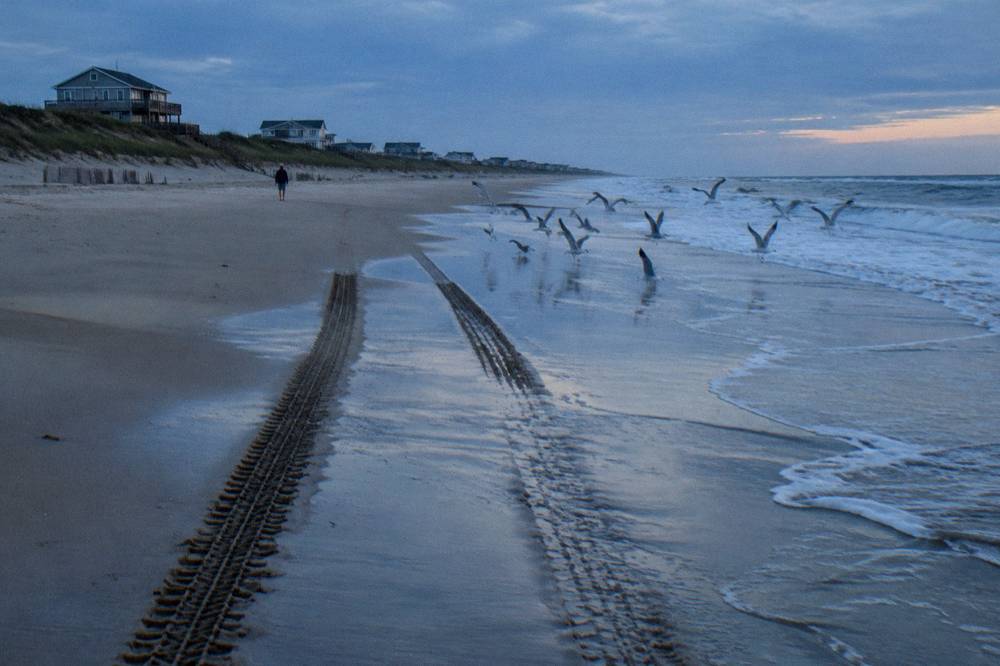
Rental agreements deserve a careful read before you point a rental north. Many standard Outer Banks rental contracts prohibit beach driving entirely, and violating one can void coverage for any damage incurred on the sand. Air down, drive the wet sand near but not in the water, avoid the soft stuff above the tide line, and expect the drive itself to eat an hour or more of your day. Our companion piece on driving the Corolla 4x4 beach versus a guided tour breaks the vehicle logistics down in detail.
This is the honest pivot point of the whole question. A self-guided trip is free only if you already have a suitable vehicle, sand-driving confidence, and a tolerance for covering miles of beach with no guarantee. The guided 4WD truck tour compresses all of that into two hours with a driver who does this daily, which is exactly why so many first-time visitors land on it after pricing out a rental upgrade they did not really want.
When Are The Horses Easiest To Find On Your Own?
The horses move predictably with the seasons: in spring and summer, biting insects and heat push them out of the maritime forest and onto the open beach and sound-side edges, where self-guided viewers have the best odds. Late afternoon and early morning beat midday, and overcast, breezy days often beat bluebird ones.
Seasonal movement is the single most useful piece of inside knowledge for a self-guided viewer. Reporting on the 2026 season described it well: the horses are not multiplying, they are relocating, seasonally and predictably, in response to conditions that repeat every year. In April, biting flies and shifting winds push horses out of secluded areas onto the beach. Through the height of summer, heat stress does the same job the insects did earlier, forcing animals out of cover and into the open where people can see them from a distance.
Two horses died after being struck by vehicles in 2025, out of four struck that year, a grim reminder of why the county asks drivers on this beach to keep speeds low and attention high. A horse can appear between dunes with no warning, and a moment of inattention at speed is the worst-case scenario for everyone involved. If you drive yourself, treat every blind dune crest as if a band were standing behind it.
For walkers, the same biology applies with a bonus: the beach near the access point at the end of the pavement is exactly the corridor horses use in summer to escape the flies. Arrive early, before tour traffic thickens, keep to the wet sand, and scan the dune line rather than the horizon. The odds are never a promise, but the pattern is real and repeatable. For a fuller breakdown of timing, see the best time of day to see Corolla wild horses.
What Free And Cheap Options Exist Besides The Beach?
The realistic no-sand options are the Corolla Wild Horse Fund's museum and gift shop in Corolla village, the seasonal Mustang Mornings program at the Fund's Grandy farm on the mainland, and simple patience at the village's northern edge. None of these guarantees a wild horse sighting, but the museum and farm offer tame rescue mustangs you can genuinely meet.
The museum and gift shop sit at 1130E Corolla Village Road, open seasonally Tuesday through Saturday, 10 a.m. to 4 p.m. It is the best single place to learn the herd's story, and it sits a short walk from the Corolla village area where horses occasionally appear. Admission pricing is not published online, so check with the Fund before you plan around it. Mustang Mornings, in 2026, ran on Wednesdays from May 27 to August 26, 9 a.m. to 1 p.m., at the Betsy Dowdy Equine Center in Grandy with a suggested $10 per vehicle donation at the gate, including a screening of the Fund's 32-minute documentary. The farm is otherwise closed to visitors outside scheduled events, so the Fund's calendar is the source of truth for the next season's dates.
| Option | Cost | Chance of seeing wild horses | Effort level |
|---|---|---|---|
| Walk north from the NC-12 terminus | Free | Moderate in warm months | High, no shade |
| Drive the 4WD beach yourself | Fuel and vehicle wear | Moderate to good | High, needs 4WD skill |
| Village-edge patience | Free | Low, unpredictable | Low |
| Fund museum and gift shop | Check with the Fund | None for wild horses, exhibits inside | Low |
| Mustang Mornings at Grandy | Suggested $10 per vehicle | Rescue mustangs, not the wild band | Low, mainland drive |
| Guided 4WD truck tour | From $65 per person | Good, guide tracks the bands daily | None, you ride |
The rescue horses at the Grandy farm are not the wild band, and saying so plainly matters. They are former wild horses the Fund took in for medical or behavioral reasons. Meeting them is a different, gentler experience, and it is the only setting where getting close to a Corolla mustang is appropriate. If your heart is set on the wild herd itself, the farm complements a beach day rather than replacing one, a distinction our guide to free ways to see the Corolla wild horses explores at length.
When Does A Guided Tour Beat Going Alone?
A guided tour makes more sense when you have no 4WD vehicle, when your Outer Banks time is short, when small children rule out a long hot walk, or when you want local interpretation rather than just a sighting. The featured 2-hour 4WD truck tour runs from $65 per person, is rated 4.8 across 2,871 reviews, and caps groups at 12 travelers.
Notice what a guide actually adds. The listing for the 2-hour Outer Banks Wild Horse Tour by 4WD Truck describes transport by open-air four-wheel-drive truck, no ATVs, with a friendly professional horse guide, meeting at 1148 Ocean Trail in Corolla, a parking lot shared with the Beer Garden. The operator's license, the vehicle, the driver's daily knowledge of where the bands are ranging: those are the three things a self-guided visitor must supply personally, at the cost of a rental upgrade or a long walk with uncertain payoff. The booking page shows the live price and current departure times.
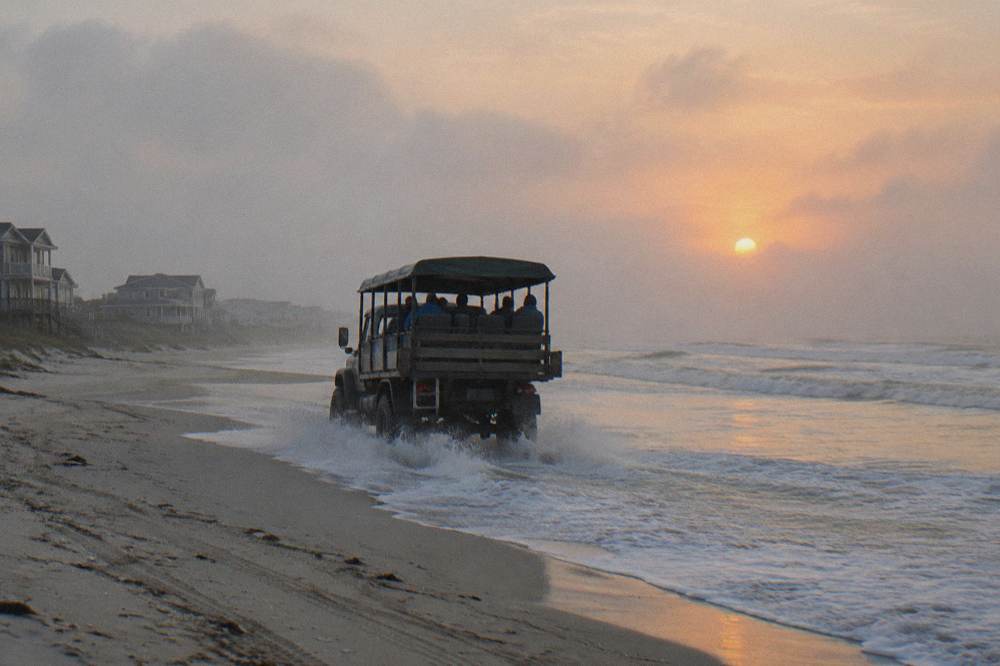
Families should weigh the age rules on both routes. The featured tour cannot accommodate children under five years or under 40 pounds, and it is not recommended for travelers with back problems, since the ride is genuinely bumpy across the sand. A self-guided walk has no age limit at all, which makes it the default for parents of toddlers, at the price of carrying everyone's water and accepting a lower sighting probability. Our piece on Corolla horse tours with kids works through that trade in detail.
The honest summary is that free and guided are not competitors, they are tools for different travelers. If you have a 4WD, a half day and a spirit of adventure, go yourself, follow the 50-foot rule religiously, and enjoy the hunt as much as the find. If you have one morning, a sedan and a five-year-old, the open-air truck from the Ocean Trail lot is the version of this experience that reliably fits. Either way, the horses are the same animals, the law is the same law, and the memory is yours either way.
Common Questions About Seeing Corolla Wild Horses Without A Tour
Can you see the Corolla wild horses without a tour?
Yes. The horses roam freely across the 4WD beach and back-dune area north of Corolla, and no guide is required to view them. You need a four-wheel-drive vehicle to drive the sand, or you can walk north from the end of the paved road. You must stay at least 50 feet from every horse, and no option, guided or not, guarantees a sighting.
Is it free to see the wild horses in Corolla?
Walking to look for them is free. Driving the 4WD beach yourself costs fuel and vehicle wear but no tour fee. The Corolla Wild Horse Fund's museum is in Corolla village, and its Mustang Mornings farm program in Grandy asked a suggested $10 per vehicle donation in its 2026 season. A guided 4WD truck tour runs from $65 per person.
Can you touch the wild horses in the Outer Banks?
No. Currituck County's wild horse ordinance makes it unlawful to come within 50 feet of a wild horse and unlawful to feed, pet, ride or lure one, and violations are punishable by law. The only close-up contact with Corolla mustangs happens with the Fund's rescued horses at scheduled farm events, never with the wild band.
Do you need a 4x4 to get to Carova Beach?
Yes, if you are driving. The paved road ends in Corolla and the beach becomes the only through route to Carova, North Swan Beach and Swan Beach. The U.S. Fish and Wildlife Service states four-wheel drive is required once traffic diverts onto the sand, and county guidance says not to attempt the beach without it.
What is the best time of day to spot the horses on your own?
Early morning and late afternoon tend to be the most productive, and in the warm months the horses move onto the open beach to escape biting insects and heat. Overcast or breezy days often improve visibility since the horses spend less time in the shade of the maritime forest. No time of day promises a sighting.
Are the Corolla wild horses dangerous?
They are wild animals and should be treated as such. The Fund warns that close approaches can stress the herd and separate foals from their mothers, and horses may defend space if crowded. Keeping the required 50-foot distance, never positioning yourself between a mare and foal, and photographing with a zoom keeps everyone safe and lawful.